Automated archive / Big Walk
Big Walk Turns a Chill Hike into a Million-Unit March
Big Walk has quietly turned a slow, social hike into a million-unit commercial march, proving low-combat co-op worlds can compete with blockbuster powerhouses. This week’s intel breaks down its sales surge, design thesis, and what its success means for future gamedev and indiegame strategies.
AI-generated summary. This archive article does not have a current recorded source check. Check linked sources before relying on details. Editorial policy

Watch: Transmitting Gameplay footage from the field: Big Walk official operations reel
Sector Overview: Big Walk’s Slow Hike, Fast Climb
Big Walk has quietly executed one of 2026’s sharpest pivots from niche curiosity to commercial force. Over the last week, the co-op hiking sim has crossed 1,000,000 paid units sold, not counting its fresh deployment as a PlayStation Plus Monthly Game on PS5. For a low-combat, social-first experience, that’s a serious market signal: players are willing to invest in long-form, low-urgency co-op worlds when the design is confident and the social loop is tight.
From a #gamedev and #indiegame perspective, Big Walk is now a live case study in how to scale a "vibes-first" concept into a mainstream hit without bolting on combat or traditional progression spines. The game is selling the fantasy of being together in a place—and the data suggests that fantasy travels.
Market Intel: Million-Unit Threshold & Steam Top Seller Positioning
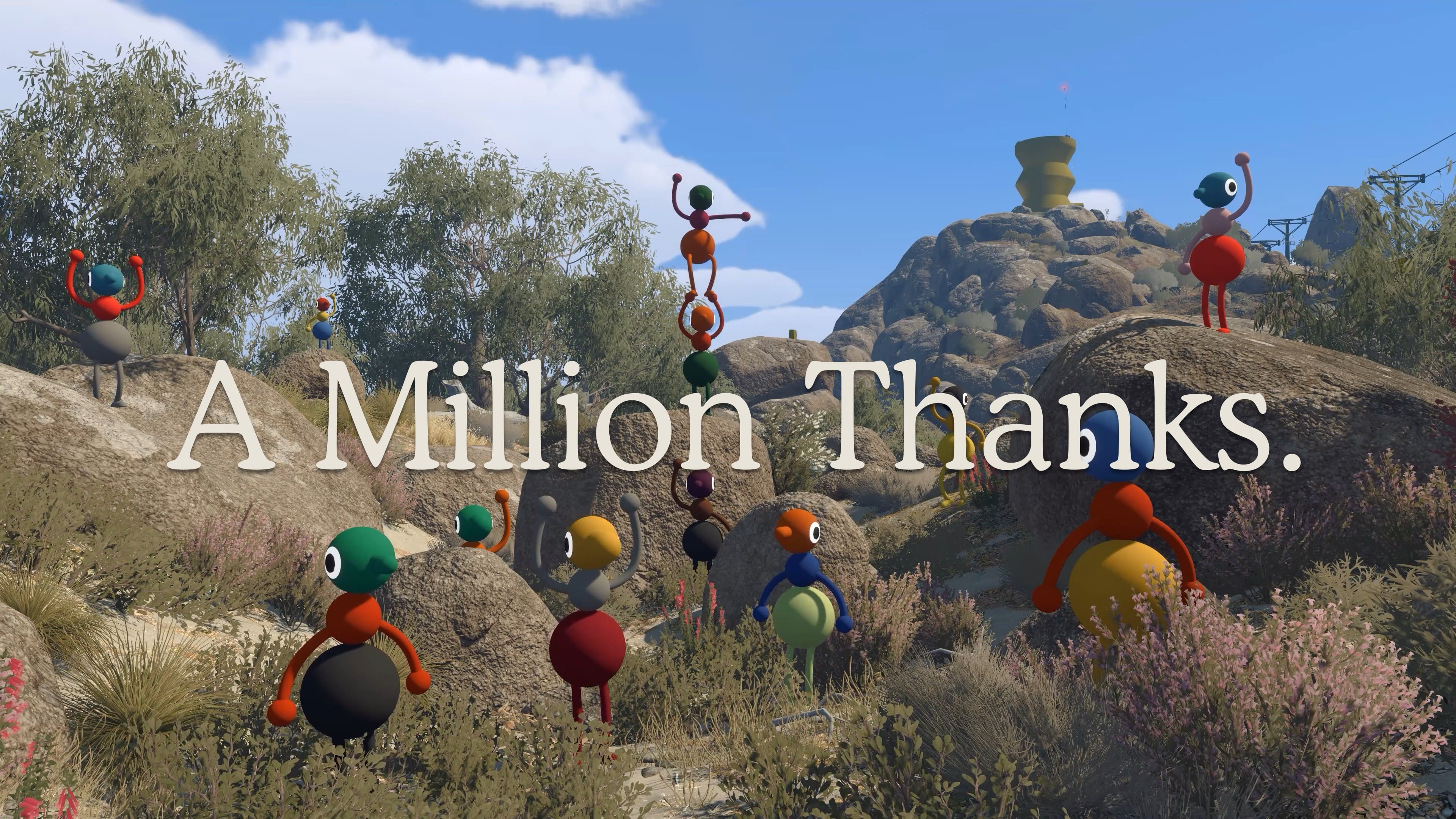
The key commercial datapoint this week: Big Walk has breached the one-million paid unit mark ahead of its PS Plus inclusion. That means the current player base—and word-of-mouth velocity—has been built on direct purchases, not subscription uplift.
On Steam, the latest 4–11 August 2026 top-seller grid places Big Walk in the upper tier of the stack, marching alongside heavy hitters like MARVEL Tōkon: Fighting Souls and the ever-resilient Cyberpunk 2077. For market-watchers and design leads, that positioning matters:
- Genre contrast: Big Walk is winning share without combat, loot treadmills, or high-intensity skill ceilings.
- Pricing & value perception: A chill traversal sim is holding its own in a market where content volume usually dictates perceived value.
- Cross-ecosystem presence: Paid units + PS Plus exposure suggests a long tail of new squads entering the ecosystem over the next quarter.
For studios tracking sustainable models, this is a concrete proof point that cozy-multiplayer ops can be commercially viable at scale.
Design Deconstruction: Social Exploration as the Core Loop
Recent review intel frames Big Walk as “less a game and more a controlled social experiment in long-range co-op traversal.” That’s not a dismissal—it's the design thesis.
Instead of combat or high-stakes failure, Big Walk leans into:
- Navigation as tension: Getting from point A to point B is the primary challenge. Route-finding, map reading, and environmental cues carry the game’s core friction.
- Improvised communication: Players lean on non-verbal cues, in-world tools, and emergent coordination instead of complex UI or voice-only reliance.
- Shared discovery: The reward loop is seeing something together: cliff-side vistas, seaside portals, and strange environmental landmarks.
This slow-burn structure creates a low-urgency, high-charm rhythm. Squads that enjoy meandering data collection—exploring, cataloging, and storytelling—will find a high return on time invested. For designers, Big Walk underlines a critical #gamedev insight: you can build compelling co-op without combat if your world and communication tools are strong enough.
Field Capture Log: Environmental Layouts & Squad Cohesion
PlayStation’s Share of the Week: Big Walk initiative has effectively turned the community into a distributed reconnaissance network. Player-submitted images and clips are functioning as informal telemetry on how the game is actually being used:
- Scenic co-op encounters highlight how often squads stop to simply look—a subtle but powerful indicator of environmental engagement.
- Cliff-side vistas and seaside portals are emerging as natural social hubs, where groups regroup, experiment with traversal, and frame screenshots.
- Coordinated traversals are revealing how teams self-organize without explicit waypoints or hard objectives, relying on observation and experimentation.
For developers, these field captures are more than marketing fodder—they’re live UX feedback on environmental readability, pacing, and how players choreograph movement when left to their own devices.
Platform Strategy: PS Plus as Force Multiplier
Big Walk’s timing on PlayStation Plus Monthly Games is tactically sharp. The million-unit milestone establishes credibility and community density; PS Plus now injects a wave of low-friction entrants into that ecosystem.
Key strategic implications:
- Session health: Co-op games live or die on matchmaking and friend-group availability. PS Plus dramatically widens the pool of potential hiking partners.
- Retention experiments: With a broader funnel, the team can test new social tools, gentle onboarding, and long-term traversal goals without worrying about concurrency cliffs.
- Discovery loop: Share features and capture tools on PS5 amplify Big Walk’s core strength: being visually distinctive and instantly readable in a single frame.
For other #indiegame teams, this is a compelling model: prove the concept with paid units, then use subscription platforms as a force multiplier rather than a lifeline.
Strategic Takeaways for Devs and Market Watchers
From a sector-intel perspective, Big Walk’s current trajectory surfaces several actionable lessons:
1. Social Presence Can Replace Traditional Progression
Big Walk demonstrates that shared presence—being in a place with people you care about—can be a primary driver of engagement. Progression here is experiential rather than numerical. For #gamedev teams, this opens space to:
- Invest in expressive traversal and communication tools over combat balance.
- Treat the environment as a social stage, not just a backdrop.
2. Low-Intensity Doesn’t Mean Low-Stakes
While the game is structurally chill, the stakes are emotional and social: getting separated, losing the trail, or missing a landmark together carries its own tension. Designing for these soft stakes can attract players burned out on constant high-intensity loops.
3. Community Media as Design Telemetry
The recent wave of field captures—screenshots and clips from the frontlines of Big Walk—functions as a public design mirror. Watch what players choose to share, and you’ll see:
- Which biomes and set-pieces resonate.
- Where traversal feels satisfying enough to replay and document.
- How squads naturally pace their sessions.
Studios should be mining this kind of community media as aggressively as they mine heatmaps.
Big Walk’s latest week in the field confirms it’s no longer just an intriguing experiment—it’s a validated commercial and design blueprint for low-combat, socially driven worlds. As the PS Plus wave rolls in and Steam visibility holds, expect more studios to study this hike closely and recalibrate what “multiplayer” can mean in the next cycle of #indiegame development updates.
Sources and corrections
This archive entry does not have a verified article-source list. Images and video embeds alone are not evidence for every claim.
Found an error? Request a correction. Include the passage and a supporting source.
Your games, in one place
Keep up with Big Walk
Follow this game to collect its posts in your personal feed. Come back to see what you missed.