Automated archive / Apex Legends
Apex Legends Locks Down Movement Exploits and Opens Live Meta Comms
Apex Legends just locked down movement exploits, triaged a GPU-specific crash, and opened a tightly scoped live balance AMA that will shape the next wave of legend and weapon tuning. Here’s how Respawn is threading the needle between high-skill play, systemic stability, and transparent meta design.
AI-generated summary. This archive article does not have a current recorded source check. Check linked sources before relying on details. Editorial policy
Sector Snapshot: A Tight Week of Stability, Mobility, and Meta Comms
Apex Legends just pushed through a compact but high-impact cycle of changes: movement exploits are getting quarantined, a critical GPU crash is under active investigation, and Respawn is spinning up a focused live balance AMA to talk legends and weapons only. For players, this week is about trust in the live service pipeline; for #gamedev watchers, it’s a clean case study in how a mature live game triages bugs, communicates risk, and invites the community into the design loop.
Movement Meta: “Still Sweaty, Just Less Cursed”
Mobility Exploits and Core Stability
The latest Apex Legends development update quietly tackles one of the hardest problems in competitive shooters: where to draw the line between high-skill tech and outright exploits.
Key changes in the August 26 patch:
- Movement exploits contained – Respawn is explicitly targeting “cursed” traversal behaviors that break intended physics or create desync-heavy edge cases. The message is clear: advanced movement is welcome, but not when it destabilizes the netcode or invalidates map design.
- Post-reconnect rubberbanding reduced – Returning to a match after a disconnect has historically felt like fighting the server more than the enemy. Smoothing post-reconnect movement suggests a deeper networking pass, a non-trivial win for both competitive integrity and player retention.
From a #gamedev perspective, this is classic live-ops triage: protect player expression where possible, but clamp down on anything that destabilizes the simulation or creates uncounterable states.
Octane and Gibraltar: Micro-Tuning the Frontline
Two frontline legends got particularly surgical attention:
- Octane – His passive healing is now restored to its original full-health behavior. That’s a strong signal that Respawn wants Octane’s identity to remain “perma-kinetic and self-sustaining,” rather than nudging him toward a more conservative, shield-first play pattern. For the meta, this reinforces his role as a tempo-setter in both pubs and ranked.
- Gibraltar – An “unintended supersprint combo” that enabled shotgun rushes at physics-breaking speed has been hard-capped. This is less about nerfing Gibby’s power and more about removing a degenerate interaction between animation, movement, and weapon handling. Expect Gibraltar’s pick rate to remain more tied to macro utility (bubble, bombardment) than to janky mobility tech.
For competitive squads, these tweaks don’t rewrite the tier list overnight, but they clean up edge cases that could swing high-stakes fights in ways that feel unfair or unreadable.
Live Ops Triage: AMD RX 9070 XT Crash Incident
On August 25, Respawn flagged a live stability incident specifically impacting systems running AMD Radeon RX 9070 XT with the newest driver stack. The pattern: hard client shutdowns mid-match, with a recommended rollback to driver version 26.7.1.
The language here is notable: the studio is asking players to hold crash logs and avoid the newest driver “if system stability is mission-critical.” That’s effectively a soft red alert for ranked grinders, tournament players, and creators whose content pipeline depends on uninterrupted recording.
From a production standpoint, this is a textbook example of:
- Rapid issue isolation (specific GPU + driver combo)
- Public mitigation guidance (driver rollback)
- Ongoing telemetry capture (reproduction in controlled environments)
For #indiegame and #gamedev teams watching Apex Legends as a reference, this is how you manage a platform-adjacent crisis: don’t over-promise, don’t under-communicate, and give players a concrete, reversible action.
Design Comms: Focused Meta AMA on August 27
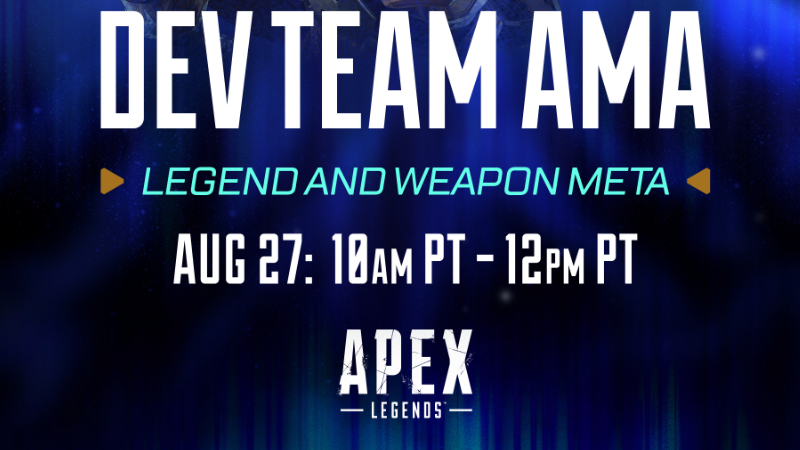
Respawn is opening a two-hour live “Meta Uplink” window on August 27, 2026, 10:00–12:00 PT, dedicated solely to legend and weapon balance. This isn’t a casual Reddit free-for-all; it’s structured like a design review with public input:
- Scope-locked: Legends and weapons only. No map requests, no monetization debates, no lore detours.
- Question discipline: Players are explicitly asked to submit 1–2 tightly grouped questions, not sprawling essays. That’s a strong signal that the design team wants actionable, testable feedback rather than broad venting.
- Routing to “design command stack”: All collected data is being funneled into the internal balance pipeline, suggesting this AMA is effectively a live intake session for upcoming tuning passes.
- Off-topic tagging: If your question doesn’t fit the scope, you’re asked to tag which future AMA you’d like instead. That’s smart expectation management and a subtle roadmap for future comms beats.
For the Apex Legends ecosystem, this means the next few balance patches are likely to be heavily informed by this specific feedback window. Expect:
- Targeted legend tuning on outliers (both over- and under-performing picks)
- Weapon meta adjustments where time-to-kill or pick rates are skewing too hard
- Potential follow-up dev notes that explicitly reference themes raised during this AMA
Strategic Read for Players and Devs
For players, the immediate action items are straightforward:
- If you’re on AMD RX 9070 XT, lock in driver 26.7.1 until Respawn clears the issue.
- Re-calibrate expectations around Octane’s sustain and Gibraltar’s mobility in close-quarters fights.
- If you care about the meta, prepare concise, data-backed questions for the August 27 balance AMA.
For developers and live-ops teams, this week in Apex Legends is a compact case study in:
- Balancing expressive movement against systemic stability
- Handling vendor-specific crash incidents without panic or silence
- Using tightly scoped AMAs as structured, high-signal design input
Apex Legends continues to operate like a veteran live service: not perfect, but consistently transparent, aggressively iterative, and increasingly comfortable letting the community peek into the balance war room.
Sources and corrections
This archive entry does not have a verified article-source list. Images and video embeds alone are not evidence for every claim.
Found an error? Request a correction. Include the passage and a supporting source.
Your games, in one place
Keep up with Apex Legends
Follow this game to collect its posts in your personal feed. Come back to see what you missed.
More to read about Apex Legends
- Source-checked briefApex Legends Wildcard AMA set for October 14
A Wildcard-focused Apex Legends AMA is scheduled for October 14, 2026, from 10 a.m. to noon PT. Players can post questions ahead of time and return when responses begin. The Wildcard AMA is...
- Source-checked briefApex Legends tests longer Plat+ matchmaking queues
Apex Legends has begun a matchmaking test for Platinum-and-higher players that may lengthen queues while the system seeks closer-ranked lobbies. The test applies to Plat+ players across every...
- Source-checked briefApex Legends fixes weapon exploits
Apex Legends received fixes for multiple weapon exploits, including issues that could alter magazine firing, reload speed, and fire rate. The announcement says anti-cheat work and enforcement...