Automated archive / Crazy Taxi: World Tour
Crazy Taxi: World Tour Reboots the Fare War With Brands, Chaos, and Kenji Kanno
SEGA’s Crazy Taxi: World Tour is scaling the classic arcade cab chaos into a global, brand-saturated ride-share battlefield, with original creator Kenji Kanno back at the wheel. This week’s intel breaks down its commercial grid overhaul, systemic traffic mayhem, and the design tightrope between nostalgia and modern...
AI-generated summary. This archive article does not have a current recorded source check. Check linked sources before relying on details. Editorial policy
Sector Overview: The Crazy Taxi Signal Goes Global
SEGA has formally reactivated the Crazy Taxi IP with Crazy Taxi: World Tour, targeting a 2027 deployment across PS5, Xbox Series, Nintendo Switch 2, and PC. First soft-pinged in 2023, the project resurfaced during the Xbox Games Showcase 2026 with a full trailer and immediate debate over how far this reboot will drift from its arcade roots.
From a #gamedev perspective, World Tour is positioning itself as a global, open-city fare-hunting platform rather than a single-city nostalgia play. The pitch: neon megacities stitched into a continuous “world tour” circuit, where players weaponize reaction time, traffic-reading skills, and route optimization to turn every intersection into a profit spike.
Design DNA: Kenji Kanno Rejoins the Circuit
The most important structural signal this week is leadership: original series architect Kenji Kanno is back at the wheel. SEGA has re-routed creative control to the designer who wired the original arcade chaos, and that has major implications for both feel and systems.
Classic Arcade Chaos, Modern Systems
Kanno’s return suggests World Tour won’t abandon the high-friction, high-reward loop that defined the arcade original:
- Short, high-intensity runs instead of bloated open-world downtime.
- Aggressive time pressure that forces risky pathing through dense traffic.
- Score-chasing economies where tricks, near-misses, and optimized routes matter as much as raw speed.
What’s new is the framing: internal language around a “global ride-share battlefield” implies systemic layering on top of the arcade core—potentially dynamic demand spikes, territory control, or asynchronous competition between players, even if the game remains primarily arcade-first.
From a #gamedev lens, this is a classic reboot problem: inject modern retention systems without diluting the instant-read, low-friction onboarding that made Crazy Taxi a cabinet killer.

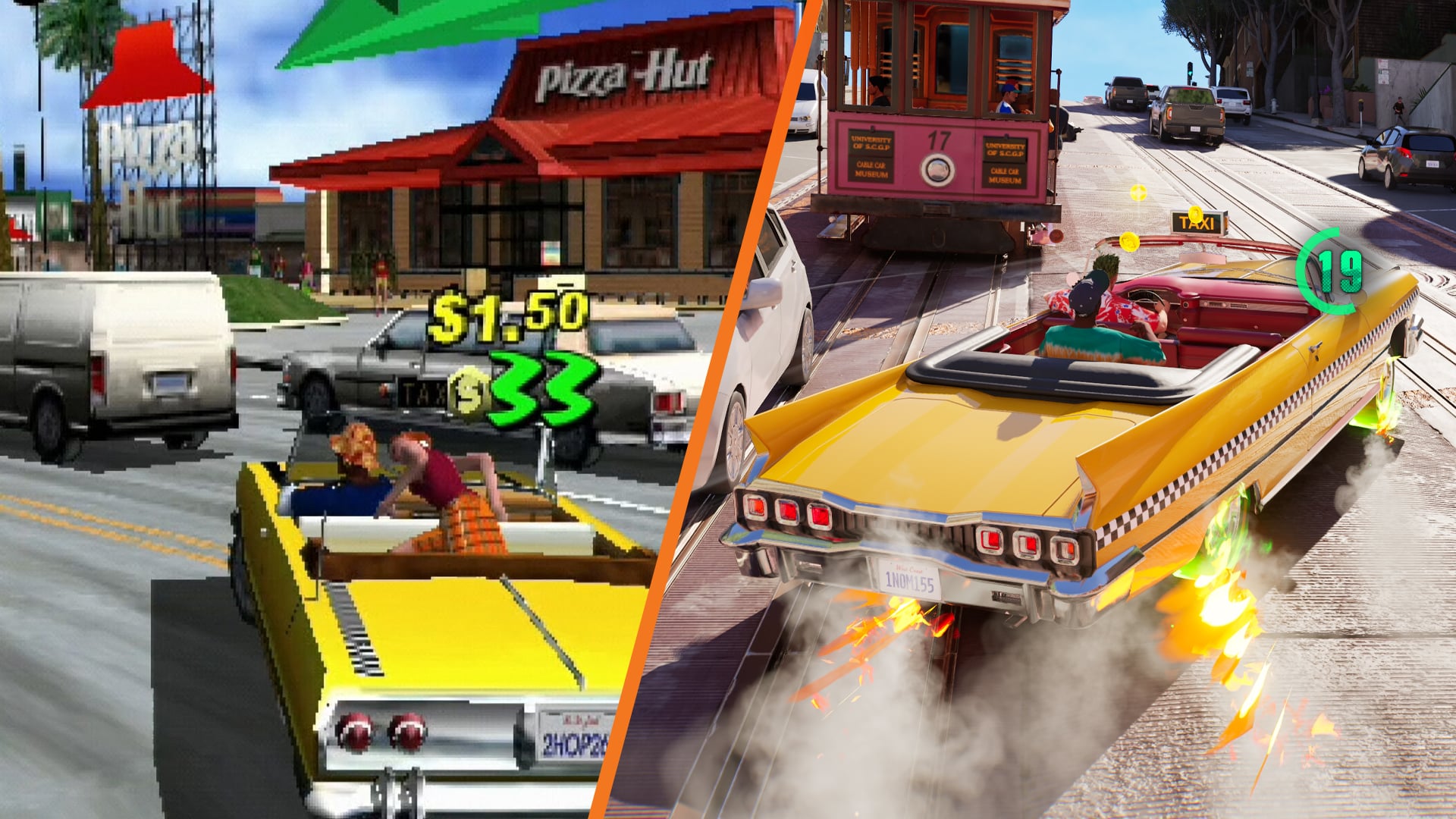
Commercial Grid: From Pizza Hut to Five Guys
One of the loudest signals in the activity feed is a complete refresh of Crazy Taxi’s commercial landscape. Where the Dreamcast era leaned on Pizza Hut, KFC, and Tower Records, Crazy Taxi: World Tour is trading that adscape for a new roster of real-world storefronts like Five Guys.
Brands as Level Geometry
The reboot appears to be doubling down on licensed brands, not backing away from them:
- Every block as billboard: Corners and intersections are being treated as ad-saturated stunt arenas, with signage density dialed up to support both visual identity and monetizable placement.
- Landmarks as routing anchors: Recognizable brands become wayfinding nodes, helping players mentally map cities while SEGA extracts additional sponsorship value.
- Dynamic commercial grids: Expect regional rotations of brands across the global tour, letting SEGA localize the cityscape while keeping the same mechanical skeleton.
For developers, this is a live case study in brand integration as environment design, rather than just UI overlays. The design risk: overloading the player’s visual field. The design opportunity: using real-world logos as functional route markers and combo anchors in high-speed play.
Systems Check: Open-City Operations at 120 MPH
The internal copy framing World Tour as an “open-city operations sim” is deliberate. This isn’t simulation in the Euro Truck sense, but the team is clearly thinking about urban throughput as a system:
- Dynamic traffic flows: Traffic appears tuned as a moving puzzle rather than background noise, with density spikes creating high-risk, high-reward corridors.
- Trick-score multipliers: Air time, drifts, and near-misses likely feed into combo meters that amplify fare payouts, encouraging players to convert chaos into currency.
- Global routing meta: A world tour structure opens the door to region-specific modifiers—weather, time-of-day, or cultural traffic patterns—without fundamentally changing the underlying ruleset.
For #indiegame developers, World Tour is worth watching as a blueprint for “arcade-first, systems-second” open worlds: small, repeatable loops scaled across multiple cities instead of a single, overstuffed map.
Community Pulse: Controversy Over Tone and Direction
The Xbox Showcase trailer has already triggered a split reception:
- Pro-reboot camp: Welcomes the global scope, modern visuals, and the promise of Kanno’s involvement as a guardrail against over-serialization.
- Skeptic camp: Worries about the tonal shift toward live-service aesthetics, heavier brand saturation, and a possible move away from the raw, punk energy of the originals.
For SEGA, the task is surgical: retain the “barely-in-control” driving fantasy while layering in progression, cosmetics, and long-term goals that modern players expect. Any drift toward grind-heavy design will be immediately visible against the franchise’s pick-up-and-play heritage.
Dev-Side Takeaways
For studios tracking Crazy Taxi: World Tour as a competitive or inspirational signal, key takeaways this week are:
- Legacy talent matters: Reinstalling Kenji Kanno is both a creative decision and a community-calming move. Reboots of classic arcade IPs benefit from visible custodianship.
- Brands as mechanics, not wallpaper: World Tour’s Five Guys-era adscape shows how licensed content can be integrated into readable, mechanically relevant level design.
- Arcade pacing in an open world: The project is a live experiment in translating short-session arcade loops into a global, multi-city structure without sacrificing intensity.
The meter’s running. As more footage and design specifics drop, Crazy Taxi: World Tour will be a critical reference point for anyone building high-speed urban systems or resurrecting dormant arcade IP in the modern market.
Watch: Transmitting Gameplay footage from the field: Secondary Crazy Taxi: World Tour trailer feed
Sources and corrections
This archive entry does not have a verified article-source list. Images and video embeds alone are not evidence for every claim.
Found an error? Request a correction. Include the passage and a supporting source.
Your games, in one place
Keep up with Crazy Taxi: World Tour
Follow this game to collect its posts in your personal feed. Come back to see what you missed.