Automated archive / Cinder City
Cinder City Dials Back the RAM Shock, Cranks Up the GPU Arms Race
Cinder City has walked back its headline-grabbing 64 GB RAM recommendation, but doubled down on a brutal GPU requirement to power its burning, physics-heavy urban killbox. This week’s intel reveals how its twin-stick MMO extraction design is quietly redefining what “minimum spec” means on PC.
AI-generated summary. This archive article does not have a current recorded source check. Check linked sources before relying on details. Editorial policy

Sector Intelligence Report: Cinder City – Week of July 3
Cinder City’s latest intel drop reframes it as one of the most technically aggressive #indiegame projects in active development. Over the last seven days, the conversation has shifted from sheer RAM absurdity to a more nuanced, but still brutal, hardware demand profile. At the same time, we’ve gotten clearer combat telemetry on what this top-down extraction shooter is actually doing under the hood to justify those specs.
This report breaks down the evolving system requirements, the combat model revealed in the vertical slice, and what it all signals for #gamedev teams watching Cinder City as a bellwether for next‑gen PC targets.
Spec Warfare: From RAM Horror Story to GPU Arms Race
64 GB Recommended RAM: Walked Back, Not Walked Away
Last week, Cinder City was making the rounds as “the MMO that eats RAM for breakfast,” with a reported 64 GB of RAM as the recommended spec. That instantly positioned it as one of the most demanding PC titles on the horizon, especially in a climate where high‑capacity DDR5 kits can climb toward four-figure price tags in some regions.
This week’s recalibration: the 64 GB recommendation has been dropped, but this is not a retreat from high-end territory. Instead, the studio has:
- Locked in 32 GB as the minimum – not recommended, minimum.
- Raised the recommended GPU tier, escalating Cinder City into a full-blown GPU arms race.
In practice, that means memory pressure is still intense. A 32 GB floor suggests:
- Heavy use of high-resolution textures and dense streaming environments.
- Potentially large concurrent player counts or complex AI simulation, consistent with MMO shooter ambitions.
- Minimal headroom for background tasks on lower-spec rigs—this is a game that wants your machine all to itself.
For #gamedev observers, this pivot is telling. The team appears confident enough in its streaming and memory budget to avoid the PR nightmare of a 64 GB recommendation, but is doubling down on visual and effects complexity. That’s a classic trade: tighten RAM usage through optimization passes, then reinvest performance into GPU-driven spectacle.
Inside the Killbox: Vertical Slice Combat Telemetry
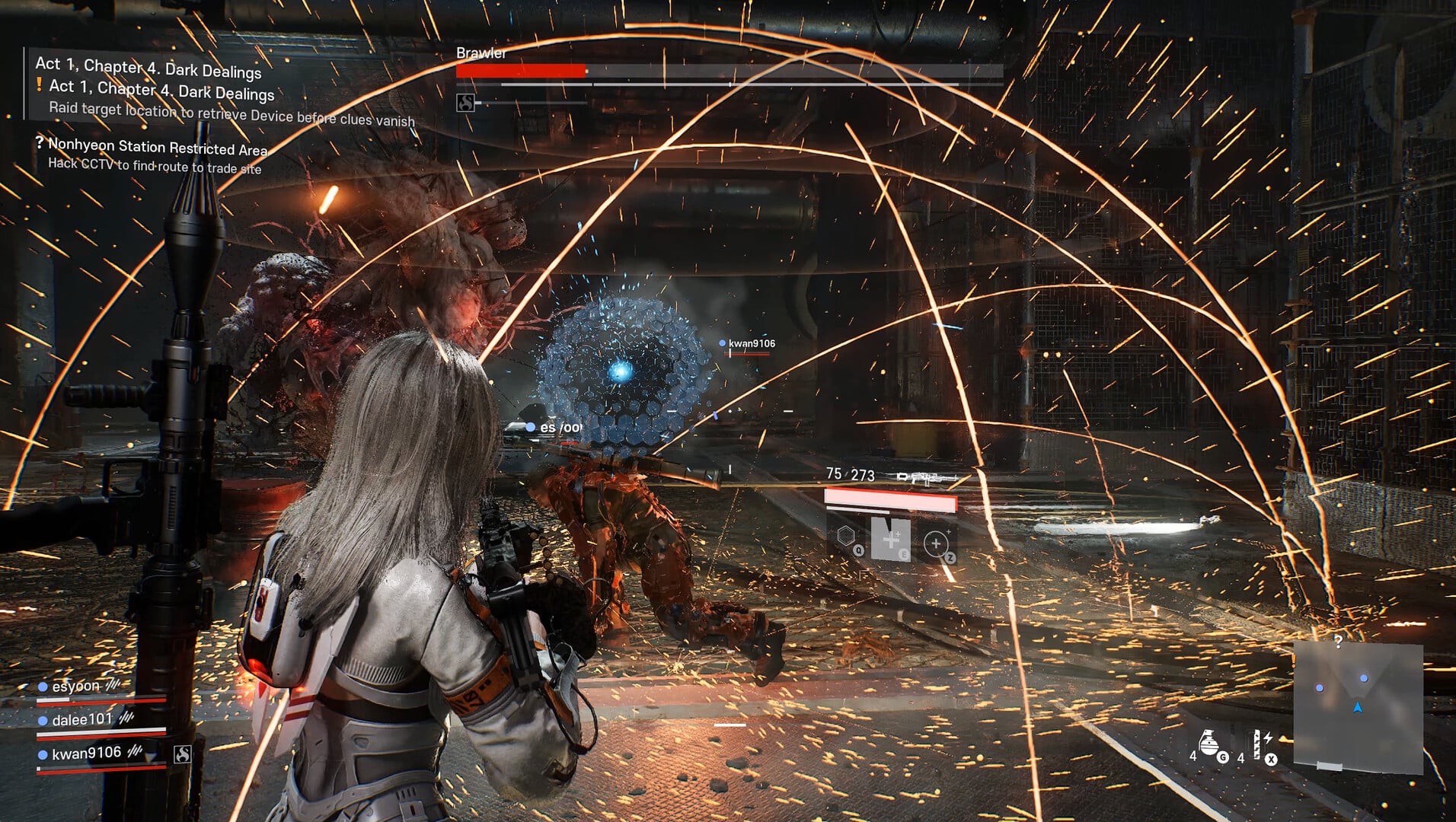
The official gameplay overview positions Cinder City as a top-down, twin-stick extraction shooter staged in a burning, multi-layered urban grid. The design pillars visible in the vertical slice help explain why the GPU bar keeps rising.
Multi-Layered Urban Density
The “burning urban killbox” framing isn’t just flavor text. The slice shows:
- Stacked verticality: overpasses, interior spaces, and layered streets that allow for overlapping sightlines.
- Persistent environmental hazards: fire, smoke, and debris that likely rely on GPU-driven particle systems and dynamic lighting.
- Physics-driven destruction: cover that shatters, props that react, and streets that feel live rather than static.
All of this pushes draw calls, particle counts, and lighting complexity into territory that naturally favors stronger GPUs.
Stealth, Extraction, and AI Pressure
Cinder City’s loop is described as a blend of:
- Stealth routing through patrol patterns and sensor cones.
- Precision twin-stick gunplay in tight quarters.
- Intel tracking across a shifting objective grid.
From a technical standpoint, that suggests:
- Non-trivial AI logic: patrols reacting to sound, line-of-sight, and destruction events.
- Dynamic threat grids: enemies and hazards reshaping the safe paths through a level.
- Server-authoritative simulation if the MMO layer is truly persistent.
Those systems lean more on CPU and network architecture, but when combined with heavy VFX and destruction, they amplify the pressure on both CPU and GPU. The RAM minimum becomes the buffer that keeps all of this responsive under load.
Why the GPU Spike Makes Sense
The decision to relax RAM recommendations while raising GPU expectations is more than a marketing clean-up; it’s a strategic recalibration.
From a #gamedev perspective, it likely reflects:
- Streaming passes maturing: texture and asset streaming systems becoming more efficient, reducing peak RAM usage.
- Visual ambition locking in: once art direction and effects targets are final, the true GPU cost becomes clear.
- Benchmark feedback: internal and external tests probably showed that GPU, not RAM, was the primary limiter on target frame rates at high settings.
For players, the message is blunt:
- If you’re on 16 GB RAM, you’re effectively out of spec.
- If you’re on 32 GB RAM and a mid-tier GPU, you may need to dial visuals down.
- If you want to see Cinder City as intended—dense crowds, maximal destruction, and full effects—you’ll need to join that GPU arms race.
Strategic Takeaways for Developers and Players
For #indiegame and mid-sized studios, Cinder City is shaping up as a case study in pushing PC baselines:
- It normalizes 32 GB RAM as a serious minimum for MMO-scale, destruction-heavy shooters.
- It signals that GPU-first optimization is becoming the real battleground as engines and tools make memory management more tractable.
- It underscores how vertical slice communication—like Cinder City’s official overview—can justify aggressive specs by clearly showing where the horsepower goes.
For players tracking this development update cycle, the directive is clear: if Cinder City is on your radar, your next upgrade decision shouldn’t just be “more RAM”; it should be smarter RAM plus a significantly stronger GPU.
As the city burns hotter and the threat grid tightens, the real question isn’t whether Cinder City is demanding. It’s whether this becomes the new normal for ambitious PC-first shooters built for the next hardware wave.
Sources and corrections
This archive entry does not have a verified article-source list. Images and video embeds alone are not evidence for every claim.
Found an error? Request a correction. Include the passage and a supporting source.
Your games, in one place
Keep up with Cinder City
Follow this game to collect its posts in your personal feed. Come back to see what you missed.