Automated archive / Assassin's Creed Shadows
Assassin’s Creed Shadows Locks In Its Final Form
Assassin’s Creed Shadows has locked in Version 1.1.11 as its final, canonical build, closing out a post-launch cycle defined by telemetry-driven tuning and targeted content drops. From the Black Tides coastal op to Animus Domains and a Black Flag crossover, this week’s intel marks the moment Shadows stops evolving...
AI-generated summary. This archive article does not have a current recorded source check. Check linked sources before relying on details. Editorial policy

Sector Overview: Shadows Enters Stable Orbit
Assassin's Creed Shadows has officially transitioned from active deployment to long-tail sustainment. With Version 1.1.11 confirmed as the final content update, Ubisoft Montréal has effectively frozen the live codebase and declared this the "stable live build"—the canonical version that will define Shadows’ legacy. For players and #gamedev observers alike, this week marks the moment the project stops evolving and starts being studied.
The last seven days have been dense: a final systems patch, an Animus-heavy endgame layer, the Black Tides coastal operation, and a stealth crossover channel to Assassin’s Creed IV: Black Flag. This is less a quiet sunset and more a controlled extraction under fire.
Post-Launch Systems Recalibration: How Shadows Got Here
The studio’s field log confirms that Assassin's Creed Shadows has undergone a full post-launch tuning pass driven by live telemetry and direct player feedback. In practical terms, that means:
Combat and Stealth Rebalanced
- Combat pacing has been recalibrated to better match the series’ new samurai-and-shinobi duality. Encounters now lean into deliberate timing windows instead of spammy exchanges.
- Stealth readability has been clarified—enemy vision cones, sound propagation, and alert states are reportedly more legible, reducing the “random fail” friction that plagued early builds.
- Enemy AI loops have been tightened, with more predictable patrols and clearer escalation tiers, giving players room to plan rather than react.
Open World and Progression Clean-Up
- Activity density across feudal Japan has been tuned to avoid checklist fatigue, pushing higher-value operations over filler.
- Traversal windows (climb points, ledge grabs, vaulting) have been smoothed, minimizing animation hitching and misreads during infiltration.
- Progression signaling is cleaner, making it easier to understand when to pivot between Naoe, Yasuke, and key narrative beats.
For #gamedev teams, Shadows now stands as a case study in how long-tail telemetry and community feedback can be weaponized to steer a big-budget production back into alignment post-launch.
Hattori Hanzo: The Demon Samurai as Frontline Shock Asset
Field intel this week spotlights Hattori Hanzo as Assassin's Creed Shadows’ new close-quarters shock asset. Where classic Assassin’s Creed protagonists leaned on hidden-blade subtlety, Hanzo is tuned for overt battlefield dominance.
Kit, Stance, and Battlefield Psychology
- Heavy Samurai Armor: Hanzo’s loadout emphasizes weight and presence. His silhouette broadcasts danger, functioning as psychological warfare as much as protection.
- Brutal Stance Shifts: His combat profile leans into stance-based transitions—shifting between guard-crushing heavies and precision counters, rewarding players who read opponent rhythms.
- Precision Parries & Executions: Parries are calibrated for high-risk, high-reward play, often chaining into executions designed for maximum visual intimidation.
From a systems design perspective, Hanzo acts as a deliberate counterpoint to Naoe’s stealth-first toolkit. Together, they let combat designers explore dual-protagonist encounter scripting—wide-open duels for Hanzo, shadow-route infiltration for Naoe.
Black Tides Protocol: Coastal Infiltration as Systems Showcase
The Black Tides quest emerges as the flagship operation for Shadows’ late-game design language. This coastal op blends infiltration, naval-adjacent tension, and synchronized assassinations under cover of storm and darkness.
Dual-Protagonist Deployment
- Synchronized strikes: Black Tides is built around dual-protagonist tactics, pushing players to alternate between Naoe’s stealth insertions and Yasuke’s frontline disruption.
- Vertical infiltration routes: Cliffs, watchtowers, and ship rigging form a vertical playground, forcing players to consider z-axis approach vectors rather than linear routes.
Environment-Driven Stealth
- Storm and darkness serve as active systems, not mere backdrops—thunder masks noise, rain affects visibility, and moving shadows create dynamic concealment pockets.
- Naval-adjacent sabotage tasks players with crippling logistics chains before the main engagement, turning side objectives into meaningful pre-fight debuffs.
Black Tides operates as a late-project thesis: a concentrated slice where combat, stealth, environment, and dual-character design converge.
Final Content Drop: Animus Domains and Black Flag Convergence
Ubisoft’s final content deployment for Assassin's Creed Shadows is both narrative and systemic. Version 1.1.11 delivers:
Animus Domains as Endgame Systems Lab
The last update instantiates new Animus Domains—endgame spaces that remix combat, stealth, and objectives into replayable permutations. These Domains function like a controlled testing arena for:
- Alternative enemy compositions
- Variant objective chains
- Difficulty and pacing experiments
From a #gamedev lens, this is Ubisoft externalizing their internal graybox arenas into a player-facing mode—turning their balancing lab into content.
Black Flag Crossover: Cross-Timeline Uplink
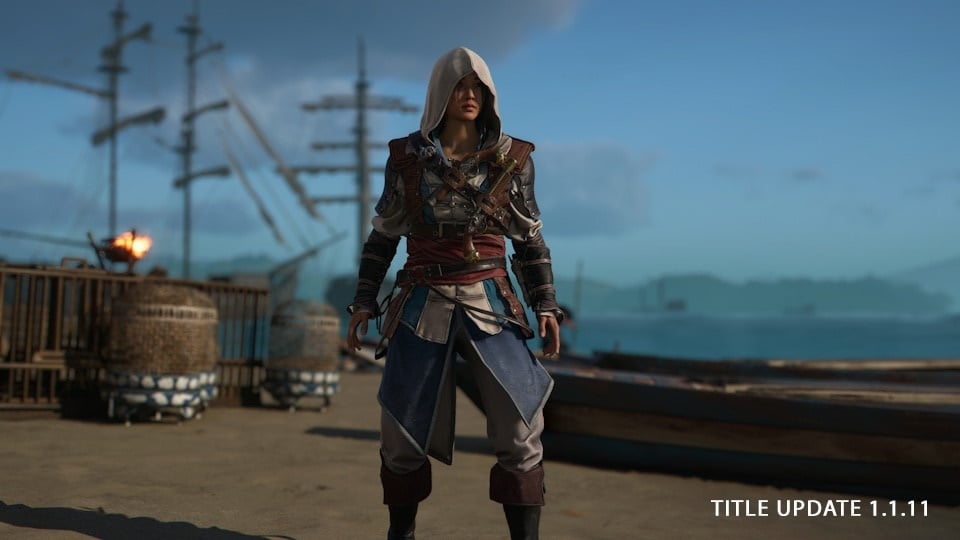
The final patch also embeds a stealth crossover link to Assassin’s Creed IV: Black Flag, syncing pirate-era intel with feudal Japan operations.
- A new quest chain sends Naoe and Yasuke against a covert Templar pair whose data footprint bleeds into Black Flag’s timeline.
- Cross-network uplink elements suggest shared Animus metadata—lore connective tissue that reinforces Assassin’s Creed’s meta-structure without derailing Shadows’ grounded tone.
For players, it’s fan-service with narrative purpose. For developers, it’s an example of how to extend a universe across titles without building a full live-service crossover event.
Strategic Takeaways for Players and Developers
With support cycles winding down, Assassin's Creed Shadows is now in its archival phase:
- Players should treat this week as the moment to reinsert: clear Black Tides, probe the Animus Domains, and run the Black Flag crossover before the discourse shifts to retrospectives.
- #gamedev and #indiegame teams can mine Shadows’ journey—from early friction to telemetry-driven stabilization—for lessons in long-term tuning, dual-protagonist encounter design, and post-launch narrative extensions.
Assassin’s Creed Shadows isn’t just closing a season; it’s crystallizing a blueprint for how large-scale historical sandboxes can be tuned, iterated, and finally locked as definitive versions in an increasingly live-driven industry.
Sources and corrections
This archive entry does not have a verified article-source list. Images and video embeds alone are not evidence for every claim.
Found an error? Request a correction. Include the passage and a supporting source.