Automated archive / Assassin's Creed Shadows
Sector Intelligence: Assassin’s Creed Shadows Locks In Its Final Build and Black Flag Crossover
Assassin’s Creed Shadows has shipped its final Title Update 1.1.11, locking in a tuned, data-driven live build and deploying the Black Tides quest plus Animus Domain endgame content. With a stealthy crossover to Assassin’s Creed IV: Black Flag, Shadows now stands as a finished, interconnected node in the...
AI-generated summary. This archive article does not have a current recorded source check. Check linked sources before relying on details. Editorial policy

Sector Intelligence Report: Assassin’s Creed Shadows – Week of June 16
Assassin's Creed Shadows has officially entered its endgame phase. Ubisoft Montréal has shipped Title Update 1.1.11, confirmed it as the final content update, and locked the live build after a months-long tuning pass driven by player data and feedback. For operators still embedded in feudal Japan, this week marks both a narrative coda and a systems hard-freeze.
This Sector Intelligence Report breaks down the Black Tides questline, the Animus Domain endgame layer, and the broader design recalibrations that now define Assassin's Creed Shadows’ permanent state on the network.
Final Content Update 1.1.11: The Build Is Now “Stable Live”
Ubisoft’s latest deployment tags Version 1.1.11 as the last major packet for Assassin's Creed Shadows. The update does three things that matter for long-term players and #gamedev watchers:
-
Locks Core Systems
The studio describes this as a full post-launch systems recalibration. Combat pacing, stealth readability, and world activity density have all been iterated on through successive patches, with telemetry and direct community feedback shaping the final parameters. Enemy AI patrol loops are cleaner, detection cones more readable, and traversal windows less friction-heavy. -
Clarifies Progression Signaling
Progression pathways—especially around side contracts and regional liberation—now surface more clearly in the UI and map logic. For design analysts, it’s a case study in how to turn messy open-world sprawl into a more legible critical path without gutting player freedom. -
Ends the Live Pipeline
Ubisoft has explicitly framed this as the last content drop: no more seasonal events, no new gear tiers, no further balance passes. Shadows is now a closed system, a finished product that will be evaluated as a complete package rather than a moving target.
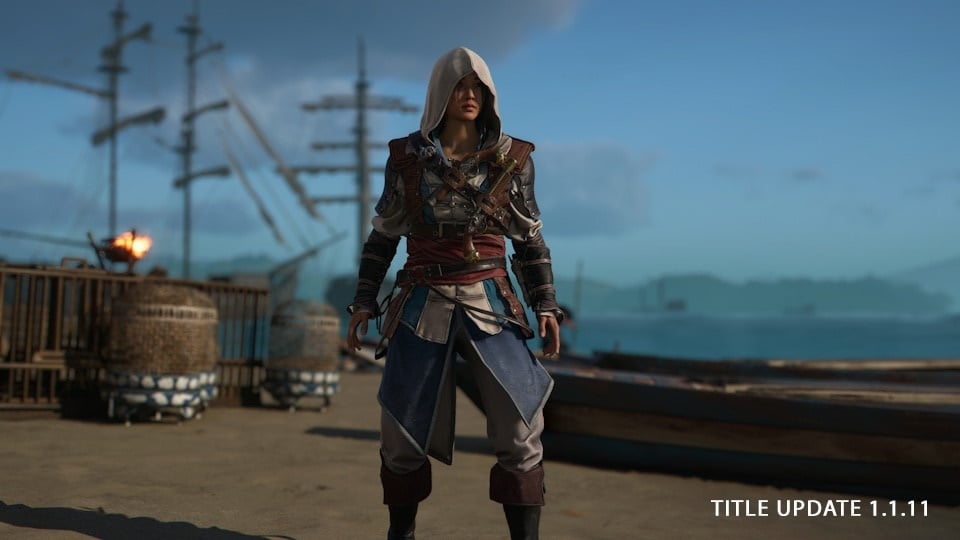
Black Tides: Coastal Infiltration as Systems Showcase
The headline content drop is Black Tides, a coastal operation that functions as both a late-game challenge and a vertical slice of Shadows’ dual-protagonist design.
Dual-Protagonist Deployment
Field intel describes Black Tides as a high-risk, high-reward coastal op that leans hard into the Naoe/Yasuke pairing:
- Synchronized assassinations: Encounters are built to reward coordinated takedowns, with one character creating disruption while the other threads through the chaos.
- Vertical infiltration routes: Rooftop chains, cliffside paths, and rigging-adjacent traversal give Naoe clear stealth channels, while Yasuke anchors the ground push.
For #gamedev observers, Black Tides reads like a deliberate stress test of Shadows’ dual-character mission scripting—less about new mechanics, more about recombining existing tools in high-density spaces.
Environment-Driven Stealth
The operation leans on storm and darkness as core pillars. Rain, low visibility, and naval-adjacent noise profiles create a stealth sandbox where timing and sound masking matter more than raw DPS. It’s a subtle but pointed reminder that Assassin's Creed Shadows is at its best when environment, AI behavior, and player tools are in tight dialogue.
Animus Domains: Endgame Systems and Replay Calibration
Alongside Black Tides, the final update activates new Animus Domains—endgame instances that remix combat, stealth, and objectives to keep the simulation viable post-credits.
Procedural Remix, Curated Intent
While not fully roguelike, Domains operate as permutation chambers:
- Objective rotations (assassinate, sabotage, extract, defend) feed into pre-authored layouts.
- Enemy compositions and patrol logic shift between runs, forcing players to re-evaluate routes instead of memorizing patterns.
- Stealth vs. aggression is no longer a binary; Domains reward flexible builds that can pivot mid-run.
For designers and #indiegame teams studying scalable endgame loops, Domains are a blueprint for low-asset, high-longevity content: reuse existing spaces, rewire behaviors and goals, and let the systemic friction do the work.
Narrative Threading to Black Flag
Crucially, this final update embeds direct connective tissue to Assassin’s Creed IV: Black Flag. A covert Templar pair becomes the narrative hinge, with cross-timeline intel syncing between Shadows and Black Flag Resynced.
From a franchise-ops perspective, this is Ubisoft using endgame content as IP glue—not just fan service, but a way to make older catalog entries feel newly relevant inside the Animus meta-framework.
Post-Mortem in Real Time: What This Means for Assassin’s Creed Shadows
With support cycling down, Assassin's Creed Shadows transitions from live experiment to fixed reference point in the series’ evolution.
- For players, this is the best time to commit: the rough edges have been sanded off, stealth and combat are more readable, and the content slate is complete.
- For #gamedev and #indiegame creators, Shadows’ journey is a live case study in data-driven iteration—how telemetry, community feedback, and targeted content drops can reshape a large-scale open world without tearing up its foundations.
- For the franchise, the Black Flag crossover and Animus Domains hint at a longer-term strategy: interconnected timelines where older entries can be reactivated through new narrative hooks.
Assassin's Creed Shadows now stands as a locked build—refined, cross-linked, and ready to be dissected as Ubisoft’s latest thesis on stealth, dual protagonists, and systemic open-world design in feudal Japan.
Sources and corrections
This archive entry does not have a verified article-source list. Images and video embeds alone are not evidence for every claim.
Found an error? Request a correction. Include the passage and a supporting source.