Automated archive / Apex Legends
Apex Legends Power Trip Turns the Live Service Into a Live Experiment
Apex Legends’ Power Trip event turns Wildcard mode into a live combat lab, while targeted patches to Axle, Conduit, and Kings Canyon quietly reshape the meta. From vials and EA Play rewards to aggressive mobility experiments, Respawn is treating its battle royale as an evolving design experiment rather than a...
AI-generated summary. This archive article does not have a current recorded source check. Check linked sources before relying on details. Editorial policy
Sector Intelligence Report // Apex Legends Weekly Brief
Respawn just flipped the breakers on Apex Legends’ Power Trip event and quietly pushed a pair of surgical balance and quality-of-life patches that will ripple through both casual queues and competitive lobbies. This week the live-service shooter feels less like a static product and more like an ongoing #gamedev lab test, with systems being stress-tested in real time.
From high-voltage limited-time modifiers to targeted nerfs for Axle and Conduit, the design team is experimenting aggressively while still shoring up long-standing pain points. Here’s how the last seven days reshape the arena.
Power Trip Event: Wildcard Mode as a Live-Design Sandbox
Watch: Transmitting Gameplay footage from the field: Official Apex Legends Power Trip Event Trailer
Power Trip’s Wildcard mode is the headline experiment—a rotating modifier suite that essentially turns each five-round run into a different design prototype. Instead of a single ruleset, Respawn is cycling through discrete combat fantasies to collect data on what players actually enjoy and where the sandbox breaks.
Escalating Modifiers and Combat Identity Tests
Each Wildcard sequence alternates between baseline skirmishes and anomalous modifiers:
- Featherweight: Double jumps and rapid falls push Apex Legends’ already snappy movement into near-arena-shooter territory. For #gamedev observers, this is a clean test of how far mobility can be pushed before readability and hit registration suffer.
- Armored Up: Universal red armor and knockdown shields compress the TTK, amplifying resource management and focus fire. This is effectively a late-game ranked loadout pushed to the entire lobby from the start.
- Red Handed: Mythic-grade weapons across the board flatten the loot curve, turning positioning and team play into the primary differentiators. It’s a meta probe: if everyone has god-tier guns, what actually wins fights?
Other rounds get weirder: Small Fry miniaturizes silhouettes, crouch-based stealth camo redefines sightlines, and synchronized blind box weapon drops create forced parity between squads. For players, it’s chaos; for designers, it’s telemetry gold.
Movement, Ordnance, and the Edge of Chaos
Wildcard’s adrenaline rush profile spikes sprint speed, adds hyper slides, and layers in on-demand wallrunning with extra boosts on confirmed knocks. Combined with infinite ordnance and self-destruct on death, it pushes Apex Legends towards an almost roguelite tempo—short life spans, explosive engagements, and constant repositioning.
The inclusion of Blank Slate rounds—where all modifiers are stripped—acts as a control group. Respawn can directly compare player behavior and engagement metrics between pure ruleset and fully modded chaos, a classic live-ops A/B test executed inside a blockbuster shooter rather than a small #indiegame prototype.
Wildcard operates on a dedicated tri-map rotation: Kings Canyon, Olympus, and Broken Moon. This ensures the team can study modifier performance across three distinct spatial archetypes: classic chokepoints, open sightlines, and fractured verticality.
Reward Economy: Vials as Experimental Currency
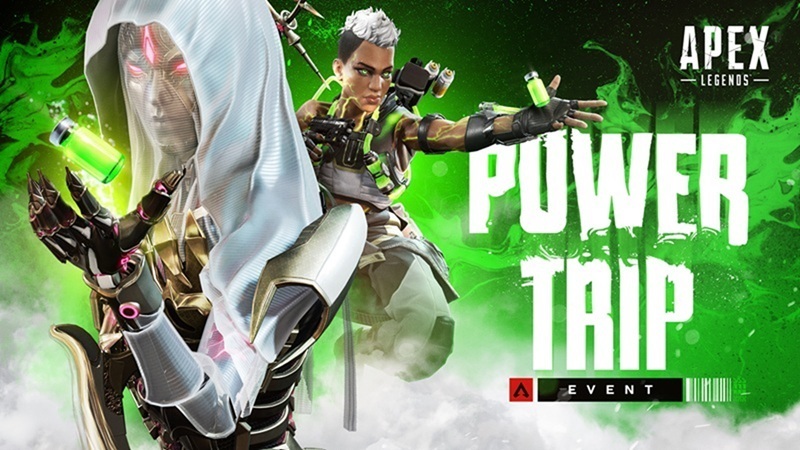
Instead of a traditional battle pass track, Power Trip leans on vials as a dedicated event currency. Players earn vials through Wildcard runs and cash them in for bio-enhanced cosmetics and experimental gear in a limited-time rewards shop.
From a systems-design standpoint, this does three things:
- Decouples playtime from linear progression – letting players target specific rewards instead of grinding a fixed ladder.
- Incentivizes repeat runs in the most data-rich mode (Wildcard) without locking core progression behind it.
- Tests alternative monetization-adjacent structures that could inform future events or even permanent store rotations.
For Apex Legends’ long-term health, these experiments matter as much as the cosmetics themselves. They’re quiet probes into what reward pacing and player agency models keep the ecosystem healthy without tipping into fatigue.
Balance Uplink: Axle & Conduit Reined In
The Axle and Conduit balance pass is a more traditional development update, but it’s no less important for the live meta.
Axle: Nitro Gate Saturation Curbed
Axle’s Nitro Gate deployables have been hard-capped and had their effective armor reduced. The intent is clear: reduce trap saturation and burst stall in tight corridors where multiple gates could stack into near-impassable kill funnels.
For competitive squads, this means:
- Less reliance on Axle as a single-point denial specialist.
- More emphasis on timing and placement over sheer quantity.
- Cleaner visual and audio information for attackers pushing through chokes.
Conduit: Sustain Without Infinite Batteries
Conduit’s radiant transfer grid now ticks slower, lasts longer, and offers reduced total sustain. In practice, this should:
- Keep barrier windows tactically relevant.
- Stop teams from chaining Conduit sustain into effectively endless frontlines.
- Force more deliberate push timings and retreat calls, instead of brawls defaulting to whoever brought a Conduit.
Together, these changes aim to restore some agency to teams that opt out of the hard-sustain meta, while still preserving each Legend’s identity.
Stability Sweep: Kings Canyon Geometry and Respawn QoL
A smaller patch quietly addressed two friction points that have outsized impact on moment-to-moment play.
- Kings Canyon geometry fixes: Hard light reinforcements were occasionally yeeting players out-of-bounds, turning the map itself into an unintended final boss. That’s now contained, reducing random, non-skill deaths and improving competitive integrity.
- Respawn beacons now grant a white backpack by default. This small tweak significantly reduces the post-respawn scramble, letting squads re-enter fights faster and with less loot RNG.
For live-service shooters, these are classic quality-of-life micro-fixes that don’t headline trailers but meaningfully improve player retention.
EA Play Integration: Charm Rotations and Ecosystem Strategy
EA Play subscribers now get rotating in-game rewards for Apex Legends, starting with an exclusive weapon charm. On paper it’s a cosmetic freebie; strategically, it’s a way to:
- Funnel players into the broader EA ecosystem with trial access and a 10% digital discount.
- Keep Apex Legends sticky by tying it into a subscription loop where progress from 10-hour trials carries into full purchases.
For #gamedev teams watching from the outside, this is another data point in how major publishers align live-service titles with subscription platforms without undermining in-game economies.
Sector Outlook: Apex Legends as Ongoing Experiment
This week’s activity underscores a clear direction: Apex Legends is less a static product and more a continuously iterated live experiment.
- Wildcard tests the outer limits of mobility, TTK, and information density.
- Axle and Conduit tuning recalibrates the ranked and competitive meta.
- QoL patches and EA Play integration refine the ecosystem around the core loop.
For players, it means a volatile but vibrant schedule where every login can feel materially different. For designers, analysts, and #indiegame devs watching from the sidelines, Apex Legends continues to function as a high-budget case study in data-driven live-ops design—one where the lab rats shoot back.
Sources and corrections
This archive entry does not have a verified article-source list. Images and video embeds alone are not evidence for every claim.
Found an error? Request a correction. Include the passage and a supporting source.
Your games, in one place
Keep up with Apex Legends
Follow this game to collect its posts in your personal feed. Come back to see what you missed.
More to read about Apex Legends
- Source-checked briefApex Legends Wildcard AMA set for October 14
A Wildcard-focused Apex Legends AMA is scheduled for October 14, 2026, from 10 a.m. to noon PT. Players can post questions ahead of time and return when responses begin. The Wildcard AMA is...
- Source-checked briefApex Legends tests longer Plat+ matchmaking queues
Apex Legends has begun a matchmaking test for Platinum-and-higher players that may lengthen queues while the system seeks closer-ranked lobbies. The test applies to Plat+ players across every...
- Source-checked briefApex Legends fixes weapon exploits
Apex Legends received fixes for multiple weapon exploits, including issues that could alter magazine firing, reload speed, and fire rate. The announcement says anti-cheat work and enforcement...