Automated archive / Screamer
Screamer Turns ’90s Neon Drift Into a Weaponized Killbox
Screamer has breached the grid with a ruthless fusion of ’90s DOS racing, anime impact, and no-compromise arcade brutality. Over the last week, every new transmission has reinforced a clear message: this indiegame is a neon killbox built for players who miss when racing games wanted to break you.
AI-generated summary. This archive article does not have a current recorded source check. Check linked sources before relying on details. Editorial policy

Sector Intelligence Report // Screamer
Screamer has officially gone loud. Over the last seven days, the project has shifted from cult curiosity to full-grid incursion, with a launch trailer, deep-dive feature, and performance review all hitting the network in rapid succession. This isn’t just another retro racer; it’s a tightly scoped #indiegame that weaponizes ’90s DOS-era speed, anime spectacle, and unforgiving arcade design into a single, neon-drenched killbox.
From a #gamedev perspective, Screamer is a case study in disciplined nostalgia: minimal comfort features, maximal identity. Every new transmission reinforces the same thesis—this game isn’t here to be liked by everyone; it’s here to be obsessed over by the right players.
Launch Status: Panic Protocol Engaged
The latest activity ping—“SCREAMER Systems Go Live: Panic Protocol Engaged”—confirms that the game’s full-power launch sequence is online. The language used in the transmission is telling: “no-safe-room traversal,” “killbox built to break your nerves,” and “adapt fast, reload faster, or get erased.” This is not the vocabulary of a chill, pick-up-and-play racer.
Mechanically, the launch messaging positions Screamer less like a traditional driving game and more like a combat gauntlet that happens to be running on wheels. The emphasis on “weaponized nightmares” and “breaches the grid” suggests a design priority on psychological pressure: tight time windows, punishing track layouts, and likely minimal guardrails in terms of fail states.
For developers tracking market positioning, this is a smart, high-risk move. Screamer is leaning into the fantasy of the hostile arcade cabinet—the machine that exists to beat you, not to flatter your ego. That’s a powerful hook for players burned out on over-tutorialized experiences.
Watch: Transmitting Gameplay footage from the field: Screamer Launch Trailer deployment
Vector Drift: Where ’90s Arcade Physics Meet Anime Impact
The mid-week briefing (“Vector Drift Briefing: Synthwave Asphalt Meets Anime Impact”) lays out Screamer’s hybrid identity: the game fuses ’90s arcade racing physics with high-intensity anime combat.
Key takeaways from the intel:
1. Time-Attack DNA
The reference to “tight time-attack circuits” and “drift-heavy corners” signals that Screamer is tuned around repeat runs and optimization rather than casual cruising. This is design language aligned with score-chasing and leaderboard culture—short, replayable tracks with high skill ceilings.
2. Combat as Spectacle and Clarity
“Over-the-top special attacks wrapped in neon UI and crunchy pixel art” indicates a strong visual hierarchy. In a high-speed environment, readability is everything. Leaning on anime-style telegraphs and exaggerated effects is a practical #gamedev solution: it turns attacks into both spectacle and affordance.
For an #indiegame with limited production bandwidth, this is clever resource allocation. Instead of chasing photorealism, Screamer invests in stylized clarity that doubles as brand identity.
3. Weaponized Nostalgia
The intel explicitly calls Screamer “weaponized nostalgia on a race grid” for players raised on CRT-era racers and VHS mecha. That’s not just aesthetic; it’s mechanical nostalgia:
- Snappy, low-latency inputs instead of physically accurate handling.
- Aggressive rubber-banding or AI behavior reminiscent of arcade cabinets.
- A soundtrack and UI that feel more like a late-night TV block than a modern sim.
This blend positions Screamer as a bridge between retro-heads and anime action fans—two communities that already over-index on high-engagement, high-skill games.
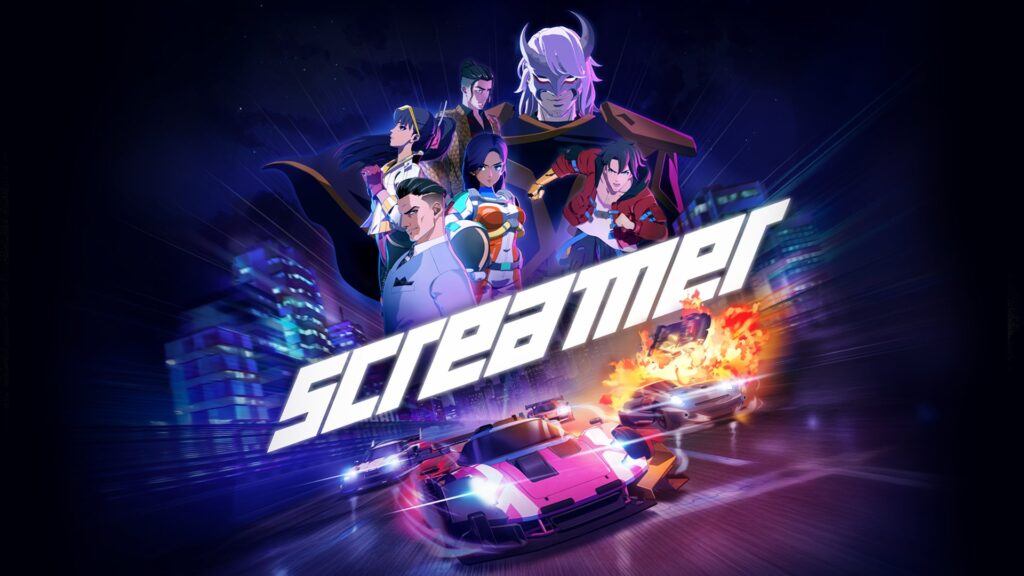
Retrofitted Carnage: Performance and Design Readout
The “Retrofitted Carnage Analysis: Screamer Performance Review Uplink” delivers concrete insight into how the game actually feels in the driver’s seat.
1. High-Velocity Homage, Not a Museum Piece
Screamer is described as a “high-velocity homage to 90s DOS racers” with “aggressive AI, twitch-heavy controls, and unapologetically arcade physics.” This matters: it’s not a 1:1 recreation of old code; it’s a modern reinterpretation of the emotion those games produced—tension, speed, and the constant risk of catastrophic failure.
For developers, this is a reminder that retro success hinges less on exact replication and more on emotional fidelity. Screamer chases the feeling of being slightly out of control at 200 kph, not the exact friction coefficients of 1995.
2. Track Design as Cognitive Load
The review flags “track layouts designed for memorization under pressure.” That’s a design philosophy that accepts frustration as part of the loop. Players are expected to:
- Learn corner sequences by heart.
- Anticipate enemy positions and attack windows.
- Execute near-perfect lines under strict time or survival constraints.
This is the opposite of modern “flow-first” design. Screamer is closer to a shmup or boss-rush in car form—each track is a pattern to decode, then dominate.
3. Minimal Comfort Features, Maximal Identity
The verdict—“pure speed-junkie nostalgia, minimal comfort features”—is a double-edged sword. From a commercial angle, it narrows the audience. From a brand perspective, it sharpens the game’s profile.
No rewind, no heavy-handed assists, likely sparse onboarding: all of this reinforces Screamer as a commitment game. You don’t dabble; you mainline it.
Strategic Outlook: Where Screamer Sits in the Grid
Across all three transmissions, the messaging is consistent and unusually disciplined for an #indiegame:
- Core fantasy: survive a neon killbox at extreme speed.
- Aesthetic lane: low-poly, saturated, CRT-era presentation with anime impact.
- Mechanical spine: time-attack loops, drift mastery, pattern memorization.
- Audience: players who romanticize the brutality of old-school arcade and DOS racers.
For #gamedev observers, Screamer is an instructive blueprint in how to build a sharp, uncompromising product in a crowded retro space. It doesn’t try to please everyone; it optimizes for the players who still remember the hum of a CRT and the feeling of losing your last credit to an unbeatable AI.
If the team can sustain post-launch tuning—balancing AI aggression, tightening readability at high speeds, and possibly layering in optional assists without dulling the edge—Screamer could carve out a durable niche as the go-to modern “mean racer.” Right now, all signals suggest a project that knows exactly what it is and isn’t afraid to floor it.
Sources and corrections
This archive entry does not have a verified article-source list. Images and video embeds alone are not evidence for every claim.
Found an error? Request a correction. Include the passage and a supporting source.
Your games, in one place
Keep up with Screamer
Follow this game to collect its posts in your personal feed. Come back to see what you missed.