Automated archive / Resident Evil 9: Requiem
Inside Resident Evil 9: Requiem’s Elpis Protocol and Loot Economy
Resident Evil 9: Requiem’s latest intel drop exposes how Capcom is weaponizing safe codes, BSAA containers, and the Elpis decision node to fuse resource tension with narrative stakes. This week’s Sector Intelligence Report breaks down the systems thinking behind the horror.
AI-generated summary. This archive article does not have a current recorded source check. Check linked sources before relying on details. Editorial policy

Sector Overview: A Week of Systems-Heavy Discovery
Resident Evil 9: Requiem’s network chatter this week has been dominated by three pillars of design intelligence: the Elpis endgame decision node, a tightly tuned resource economy built around BSAA containers and safes, and a dense lattice of lore-forward Easter eggs. For #gamedev and #indiegame teams watching Capcom’s flagship horror series, this is a live case study in how to fuse narrative stakes, exploration incentives, and nostalgia-driven environmental design into a single, coherent loop.
The latest activity feed reads like a production-side postmortem disguised as player intel: every safe code, every BSAA cache, and every hidden symbol is doing double duty as both progression system and worldbuilding device. Under the hood, Resident Evil 9: Requiem is iterating on the franchise’s classic lock-and-key grammar, but routing it through systemic choice and player-directed routing rather than pure linear gating.
Vault Protocols: Safe Codes as Micro-Pacing Tools
The compiled “Vault Protocols” data—every safe code, location, and reward—highlights how the design team is using micro-puzzles to manage tension and pacing. Safes are no longer just optional side treats; they’re structured as tactical caches that modulate difficulty spikes and ammo droughts.
From a design perspective, each safe is a pacing valve:
- Resource Pressure Relief: Codes reward players who slow down and read the environment, subtly encouraging a survival-horror tempo over pure action.
- Spatial Memory Training: Requiem leans into environmental clues and visual storytelling, rewarding players who mentally map spaces and narrative context.
- Risk/Reward Balancing: Safes often sit at the intersection of danger and payoff, tuning how aggressively players push through bioweapon corridors.
For developers, this is a clean demonstration of how to embed progression into world texture rather than UI-heavy systems—something many #indiegame horror projects can scale down without losing impact.
BSAA Container Grid: Turning Raccoon City into a Loot-Positive Maze

The “BSAA Cache Sweep Protocol” paints Raccoon City as a fully gamified logistics grid. Every BSAA container is a node in a broader resource network, pushing players to think like route planners rather than linear corridor runners.
Design implications:
- Route Optimization as Gameplay: By mapping all containers and rewards, Resident Evil 9: Requiem invites players to self-author their optimal paths, echoing immersive sim sensibilities inside a traditionally guided horror framework.
- Economy Signaling: High-value containers telegraph difficulty ramps, subtly forecasting upcoming encounters through the type and volume of loot provided.
- Replayability: Knowledge of the grid converts second runs into efficiency challenges—speedrunners and challenge-run communities get a built-in meta-game of resource minimalism.
For #gamedev teams, this is a blueprint for integrating a light “looter” layer without compromising genre identity: containers enhance survival tension instead of trivializing it.
Spectral Signal Sweep: Lore-Dense Environmental Design
The “Spectral Signal Sweep” operation—players scouring Resident Evil 9: Requiem for callbacks, symbols, and deep-cut references—underscores Capcom’s long-term narrative strategy. This is not mere fan service; it’s a continuity engine.
Key takeaways for developers:
- Legacy as System, Not Decoration: Easter eggs are structured as discoverable signals that reinforce the canon timeline and foreshadow future threats.
- Diegetic Storytelling: Lore is embedded in objects, signage, and architecture rather than isolated documents, aligning narrative discovery with exploration flow.
- Community-Driven Archiving: By encouraging players to “log each anomaly” and cross-reference series history, Capcom effectively outsources parts of its own lore documentation to the community—fuel for wikis, theory videos, and long-tail engagement.
This is a reminder that environmental storytelling is a retention mechanic as much as a narrative one.
Elpis Protocol: Branching Endgame Logic and Ethical Design
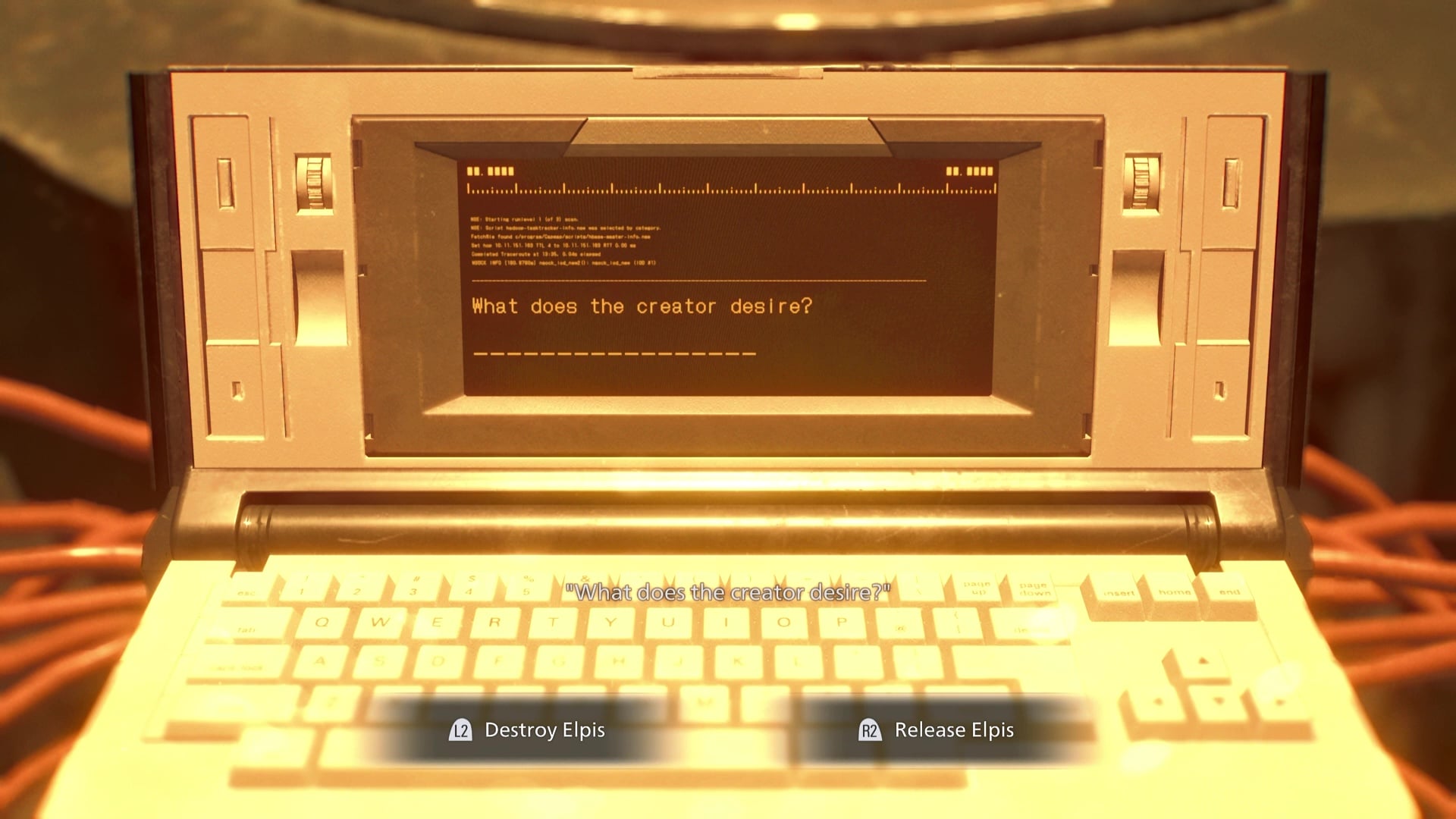
The Elpis decision node—RE9’s pivotal choice to RELEASE or DESTROY the asset—is where Resident Evil 9: Requiem’s systems cohere into a statement about agency. This isn’t just an A/B ending toggle; it’s the culmination of how players have internalized the world’s ethics and logistics.
From a design-analysis angle:
- Ethics Intertwined with Mechanics: The choice is framed around containment vs. potential salvation, mirroring the series’ recurring biohazard dilemma. Players arrive at Elpis with a history of resource scrambles, moral gray zones, and lore breadcrumbs that shape their decision.
- Narrative Telemetry: Capcom can track which path players favor—vital data for future narrative arcs and character positioning.
- Branching Without Bloat: The fork appears concentrated at a late-game node, enabling meaningful divergence in outcomes without exponential content overhead—an approach smaller studios can emulate.
For #gamedev practitioners, Elpis is a live example of how to stage a late-game moral pivot that feels earned by prior systems, not bolted on for marketing bullet points.
Strategic Takeaways for Developers
Resident Evil 9: Requiem’s latest intel cycle reveals a cohesive design philosophy:
- Use safes and containers as pacing and economy levers, not just collectibles.
- Treat lore and callbacks as systemic glue that binds exploration, fan memory, and future narrative planning.
- Anchor your branching narrative in the player’s accumulated experience of your mechanics and world, not in isolated dialogue trees.
For teams building the next wave of survival horror—AAA or #indiegame—Requiem is a working reference build on how to align resource tension, spatial design, and ethical choice into a single, tightly tuned loop.
Sources and corrections
This archive entry does not have a verified article-source list. Images and video embeds alone are not evidence for every claim.
Found an error? Request a correction. Include the passage and a supporting source.
Your games, in one place
Keep up with Resident Evil 9: Requiem
Follow this game to collect its posts in your personal feed. Come back to see what you missed.