Automated archive / Nioh 3
Nioh 3’s Combat Lab Tightens the Noose
Nioh 3’s latest week of intel confirms a sequel that doubles down on lethal, high-fidelity combat instead of broad accessibility. From visual combat telemetry to legacy system refinements, Team Ninja is turning its yokai battleground into a live laboratory for human error and player expression.
AI-generated summary. This archive article does not have a current recorded source check. Check linked sources before relying on details. Editorial policy

Sector Intelligence Report // Nioh 3
Nioh 3’s last seven days have been less about marketing noise and more about hard telemetry. Between Sony’s visual combat captures and Team Ninja’s accolade and legacy transmissions, we’re seeing a clear pattern: this sequel isn’t chasing a broader audience, it’s sharpening the blade for the players already fluent in its systems. For #gamedev and #indiegame teams studying high-friction combat design, Nioh 3 is rapidly becoming a live-fire case study.
Signal 01: Visual Combat Telemetry – Yokai Engagements Under the Microscope
The “Visual Combat Telemetry” feed from PlayStation’s Share of the Week has quietly become the most valuable design intel of the cycle so far. Frames pulled from live Nioh 3 operations show three recurring vectors:
1. Stance-Driven Micropositioning
Operators are consistently swapping stances mid-string, not just between encounters but inside single exchanges with mounted yokai. High stance initiations into mid-stance confirms, followed by low-stance recovery, suggest:
- Animation priority is tuned tighter than Nioh 2, forcing players to pre-commit to risk.
- Hitbox fidelity is supporting this aggression; players trust that if the blade passes through a hurtbox, the game will register it.
- Positional play around mounted yokai legs and flanks implies expanded weak-point logic, not just generic damage zones.
From a #gamedev perspective, this is what high-friction, high-trust combat looks like: punishing, but never visually dishonest.
2. Posture Under Pressure: Ki as a Psychological Meter
The captured frames show Ki bars being run to the absolute edge. Players are intentionally flirting with exhaustion to squeeze out one extra strike or dodge. That behavior only emerges when:
- Recovery windows are legible, even when VFX density spikes.
- Enemy telegraphs are cleanly layered over player action, so risk can be calculated in real time.
Nioh 3 appears to double down on Ki as a mental resource: an on-screen representation of player greed and discipline, not just a stamina bar.
Signal 02: Accolades Trailer – A Laboratory for Human Error
Watch: Transmitting Gameplay footage from the field: Nioh 3 Accolades Combat Briefing
The Accolades Trailer doesn’t just compile praise; it outlines the design thesis. Review pull-quotes orbit the same core idea: systematic refinement of an already brutal combat loop.
Key takeaways for combat designers:
1. Calibrated Lethality Curves
Mentions of “punishing,” “demanding,” and “precision” aren’t buzzwords here—they’re reflections of how tightly tuned the error margins are.
- I-frame windows look marginally narrower than Nioh 2, but better signposted.
- Punish states on both player and enemy are extended just enough to reward read-based play, not panic mashing.
- Yokai abilities function as both power spikes and liability traps: mis-timed activations invite catastrophic counterattacks.
This is a combat lab that assumes players will fail often—and designs the feedback loop to make each failure legible.
2. Masochistic Persistence as a Feature, Not a Bug
The trailer’s tone accepts that Nioh 3 is not meant for everyone. That’s a notable stance in a market chasing mass accessibility.
For #indiegame teams, this is instructive: instead of sanding down difficulty, Nioh 3 invests in clarity, consistency, and learnability. The “hardcore” label becomes sustainable when players can clearly see why they died and how to adapt.
Signal 03: Legacy Trailer – Iteration Over Reboot
Watch: Transmitting Gameplay footage from the field: Nioh 3 Legacy Systems Deployed
The Legacy Trailer is effectively a design whitepaper in cinematic form. It cross-references prior Nioh operations to frame Nioh 3 as a continuity of systems, not a reset.
1. Boss Archetypes: Variant, Not Redundant
Returning boss archetypes aren’t simple remasters. Their move sets and arenas hint at:
- Reauthored patterns that subvert legacy muscle memory while honoring prior reads.
- Terrain-integrated attacks, where environmental geometry is part of the boss design, not just backdrop.
- Phase transitions that escalate pattern complexity without resorting to pure HP bloat.
This is how you mine a legacy roster without drifting into self-plagiarism.
2. Expanded Buildcraft as Meta-Longevity
The trailer’s emphasis on weapon stances and yokai subsystems underscores Nioh 3’s long-tail strategy:
- Stance-specific synergies with armor traits and guardian spirits push players toward specialized loadouts instead of generic meta builds.
- Yokai abilities appear to function as modular verbs in the player’s toolkit—gap closers, crowd control, burst damage—encouraging experimentation rather than one “correct” setup.
For #gamedev teams, this is a reminder: replayability isn’t just more content, it’s systemic flexibility that allows players to author their own challenges.
Field Snapshot: Environmental Storytelling & Systems in Harmony
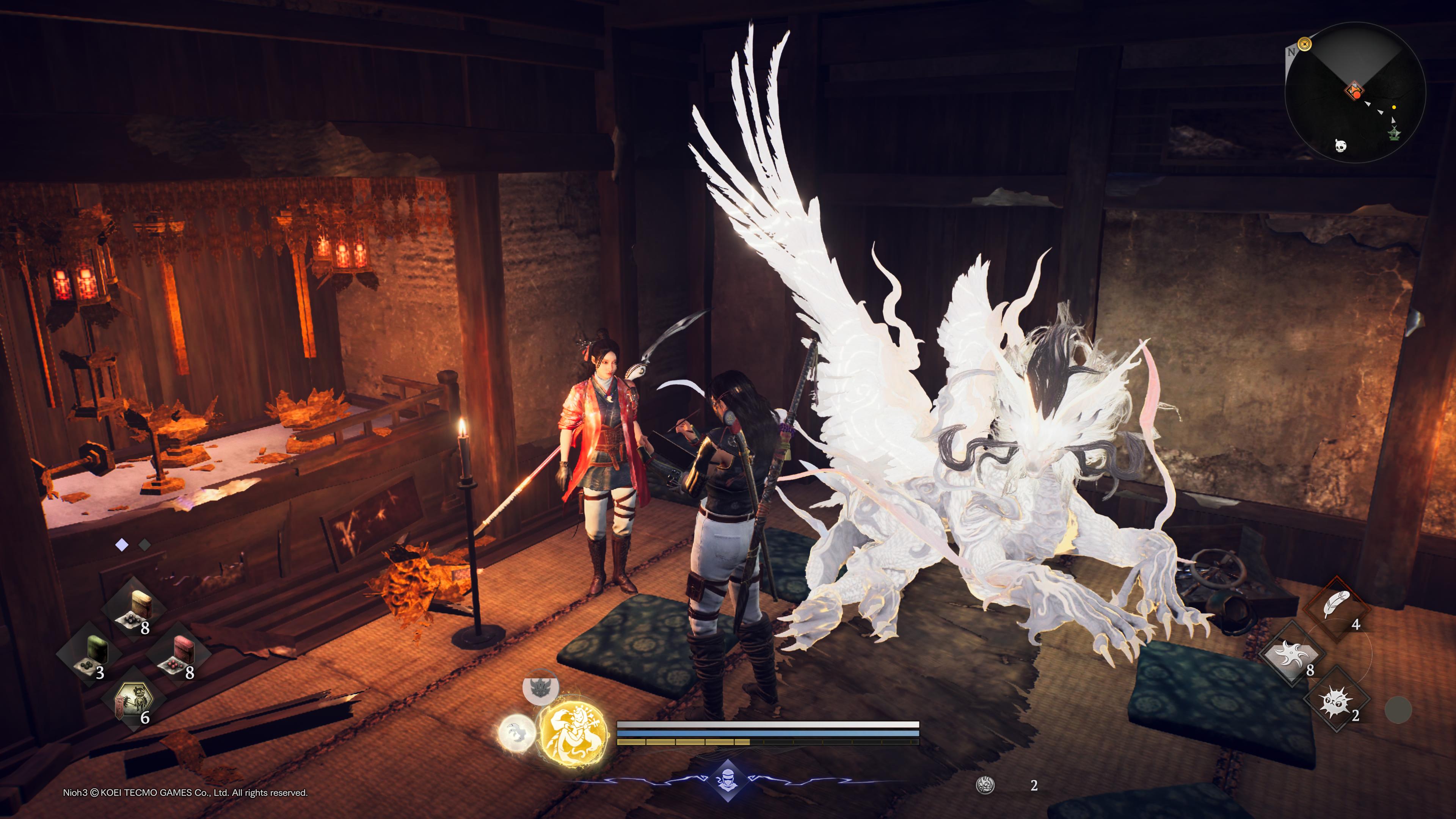
Even in stills, Nioh 3’s environments broadcast mechanical intent. Hot springs, guardian spirits, and shrine-adjacent vistas aren’t just aesthetic:
- Safe zones like hot springs provide pacing relief between high-tension encounters.
- Guardian spirit visuals telegraph build identity at a glance—an elegant UX layer for co-op readability.
- Kodama and shrine placements gently route players through difficulty spikes, acting as invisible encounter designers.
This is classic Team Ninja: brutal combat wrapped in quietly considerate macro-structure.
Strategic Outlook: What Nioh 3 Signals to Designers
Across this week’s intel, Nioh 3 is broadcasting a consistent message:
- Difficulty is non-negotiable, but legibility and fairness are aggressively prioritized.
- Legacy systems are not discarded; they’re iterated and cross-stressed under new constraints.
- Player expression via builds, stances, and yokai abilities is the primary driver of long-term engagement.
For anyone building action RPGs—AAA or #indiegame—Nioh 3 is shaping up as a pivotal reference point in how to evolve a niche, demanding combat ecosystem without diluting its identity.
Sources and corrections
This archive entry does not have a verified article-source list. Images and video embeds alone are not evidence for every claim.
Found an error? Request a correction. Include the passage and a supporting source.
Your games, in one place
Keep up with Nioh 3
Follow this game to collect its posts in your personal feed. Come back to see what you missed.