Automated archive / Marathon
Marathon’s Beautifully Brutal Live Launch and the Birth of The Loop
Marathon has officially left the lab and entered live-fire status, with Bungie framing its extraction shooter as a persistent simulation where every death is data. This week’s intel clarifies The Loop, Consequence, and a beautifully brutal visual identity that could redefine how competitive extractions feel on console.
AI-generated summary. This archive article does not have a current recorded source check. Check linked sources before relying on details. Editorial policy

Operational Overview: Marathon Is Now a Live-Fire Experiment
Bungie’s extraction shooter Marathon has moved from controlled tests to full deployment on PS5 and Xbox Series X|S, and the last seven days have been a concentrated blast of intel drops, system briefings, and aesthetic clarifications. What’s emerging is a clear thesis: this isn’t just “Tarkov in space,” it’s a persistent simulation where every run is logged, weaponized, and folded back into a wider conflict.
The launch cinematic – synced to Poppy and Son Lux’s “In Death We’ve Just Begun” – frames Marathon as a synthetic afterlife: death isn’t failure, it’s data. That narrative angle isn’t just trailer dressing; it underpins Bungie’s new pillars: The Loop, Consequence, and a seasonal pipeline that promises to mutate the battlefield in public.
Core Systems: The Loop, Consequence, and High-Stakes Extraction
The Loop: Death as Design, Not Just Punishment
Bungie’s information drop codenamed “The Loop” clarifies how Marathon’s runs are meant to feel: repeated insertions where death is expected, logged, and leveraged. Each failed exfil is an iteration in a lab experiment, not a dead end.
From a #gamedev perspective, The Loop reads like a fusion of roguelite iteration and live-service telemetry. Player behavior in each cycle feeds tuning on spawn logic, loot density, and even macro-level objectives. It’s Bungie explicitly designing around repetition with intent, rather than grind for its own sake.
Consequence: A Shared Simulation, Not Isolated Matches
The Consequence layer sits on top of the standard extraction shooter loop. Every insertion, loot pull, and exfil contributes persistent data to the wider simulation. Bungie is openly pitching a world where squad-level decisions can subtly reshape future runs for everyone, not just your fireteam.
If implemented cleanly, this could be the differentiator that prevents Marathon from feeling like a reskinned genre entry. For #indiegame teams studying systemic design, this is a live case study in networked consequence: how to make individual matches feel like they matter to a shared universe without overcomplicating the UX.
Beautifully Brutal: Readability Over Noise
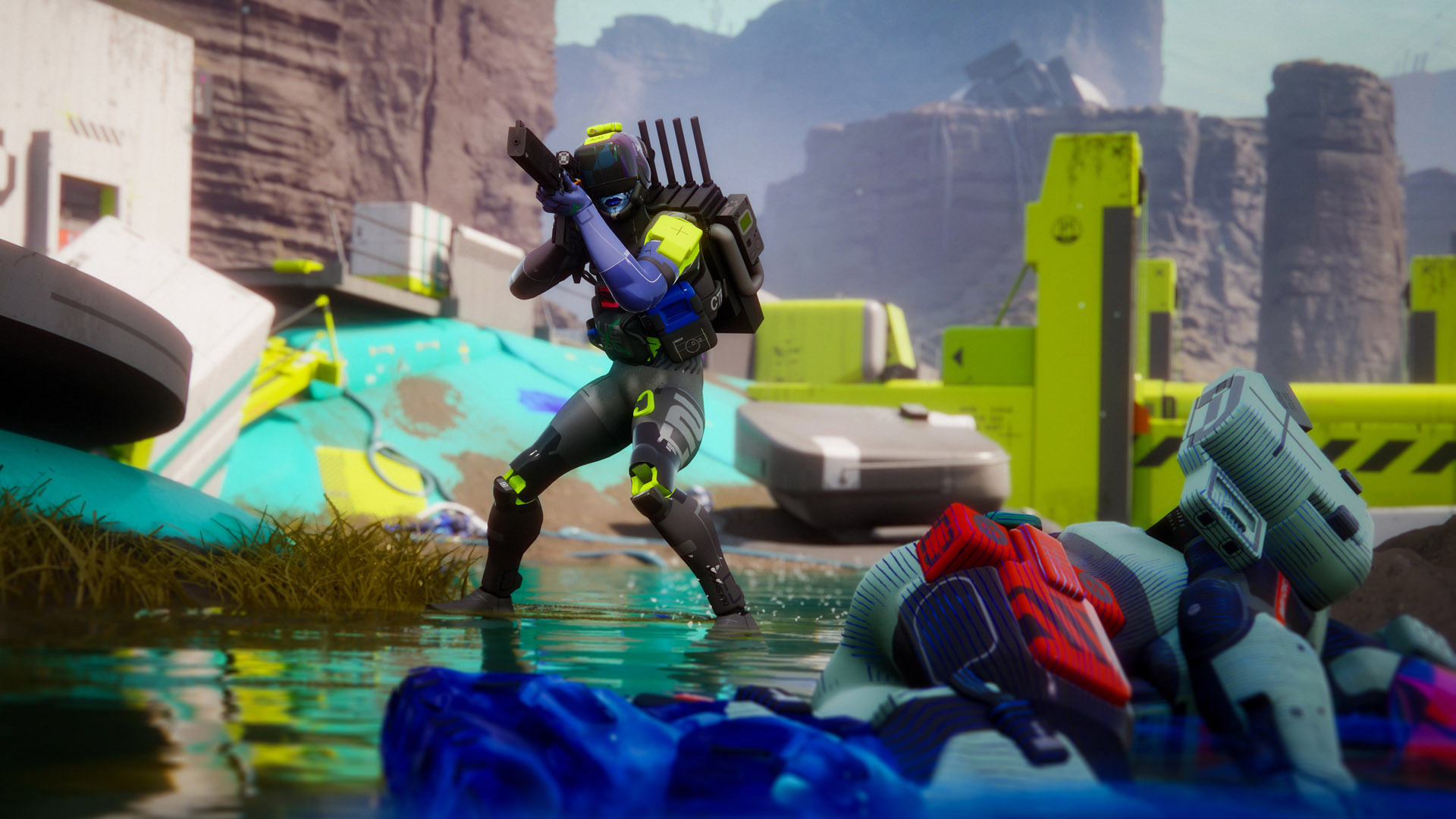
Multiple “Beautifully Brutal” transmissions emphasize a tight visual philosophy: clean sci-fi lines, lethal geometry, and hyper-readable silhouettes. Trailers highlight:
- Neon-drenched killzones with clear contrast between players, abilities, and background clutter.
- Expressive death states that communicate what killed you and from where.
- Dynamic lighting tuned for both style and instant threat recognition.
This is Bungie leaning on decades of shooter literacy: the art direction is loud, but the combat language is legible. For competitive extraction, that’s critical – the studio is clearly prioritizing information clarity over pure spectacle.
Enter Outpost and the World of Tau Ceti IV
The newly revealed Enter Outpost hub is less social space, more decontamination checkpoint. Sterile terminals, industrial lighting, and a clinical calm-before-the-storm vibe signal its role as a tactical prep zone. Expect this to be where squads finalize loadouts, sync intel, and commit to risk profiles before diving into Tau Ceti IV.
A separate Xbox-focused uplink drills into Tau Ceti IV itself: a hostile playground built for vertical traversal, flanking routes, and contested extraction funnels. Bungie’s language around environmental scans and lore fragments suggests they want the planet to feel like both a sports arena and a corporate crime scene.
Delightfully Weird: Surreal Sci-Fi as Competitive Canvas
The “Delightfully Weird” trailer and design briefing double down on Marathon’s off-kilter identity:
- Biomechanical architecture and alien neon corridors.
- A UI that feels diegetic, glitch-washed, and slightly unstable.
- An AI tone that swings from clinical to unnervingly playful.
Underneath the surreal wrapping, Bungie stresses tight PvP extraction architecture: asymmetric objectives, systemic traversal, and map layouts tuned for emergent chaos rather than pure lane-based combat. The weirdness is a skin over a very competitive skeleton.
For #gamedev teams, this is a reminder that strong identity doesn’t have to sacrifice legibility. Marathon’s UI may look like it was designed by an overcaffeinated Forerunner, but the studio keeps hammering the point that silhouettes and combat data remain readable in motion.
Live Ops, Seasons, and the Server Slam Telemetry
Bungie’s live-ops strategy for Marathon is already mapped out:
- Free seasonal updates that “evolve gameplay” rather than just add cosmetics.
- Season 2 explicitly flagged to remix existing environments and inject new gear.
- Rotating activities and a new Runner shell to keep extraction profiles fresh.
The recent Server Slam was less a marketing beta and more a hard stress test. Bungie openly framed it as a concurrency and netcode trial: disconnect patterns, latency spikes, and exploit vectors are now data points feeding launch and post-launch tuning.
For developers watching from the sidelines, this is a textbook example of how to market a technical test honestly while still rewarding participation via Server Slam rewards that carry into the live game.
Ethics, Art, and Attribution: The Fern Hook Resolution
One of the quieter but important updates: Bungie has now formally credited Fern Hook as a Visual Design Consultant after her work was previously used without permission in early Marathon promo materials. The dispute was reportedly settled in 2023, but this week’s visible credit locks it into the official record.
In a reboot this high-profile, that correction matters. It’s a signal to the industry – and to the #indiegame art ecosystem in particular – that studios can, and should, publicly rectify attribution mistakes. For Marathon’s long-term reputation, this kind of course correction is almost as important as balance patches.
Audio Front: OST, Code Race, and In-Death Atmospherics
Marathon’s OST has been declassified, with tracks like “In Death We’ve Just Begun” and the “Code Race (Brendan Angelides Remix)” establishing the game’s sonic DNA. The mix leans into:
- High-tension ambient loops for lobby dread and pre-drop anxiety.
- Rhythmic, percussive motifs tuned for repeated runs and high-focus play.
- A liminal, synthetic quality that reinforces the idea of a ritualized death-sport.
For players, it’s mood-setting. For audio teams in #gamedev, it’s a live demonstration of how to score repetition without fatigue.
Training Data: Tips, Briefings, and Onboarding the Meat Grinder
Bungie has rolled out multiple survival briefings – six core tips, then ten more specifically for Xbox operators – that all hammer the same fundamentals:
- Squad cohesion over ego-driven frag chasing.
- Motion tracking discipline and vertical sightline control.
- Resource management and intel extraction as the real win condition.
The messaging is consistent: Marathon is designed as a high-lethality sandbox where information and coordination trump raw aim. In other words, “beautifully brutal” is as much about mental load as mechanical skill.
Strategic Takeaways for Developers and Players

From this week’s signal burst, Marathon is crystallizing into three core ideas:
-
A Persistent Simulation, Not Just a Matchmaker
The Loop and Consequence systems aim to make every run feel like a logged experiment that nudges the wider ecosystem. -
Identity-First Extraction Design
Delightfully weird visuals and a beautifully brutal aesthetic sit on top of disciplined combat readability. -
Live Ops as Ongoing Experimentation
Server Slam data, free seasonal updates, and evolving maps position Marathon as a long-term lab for Bungie’s systemic design.
For players dropping into Tau Ceti IV this week, the message is simple: you’re not just fighting other Runners – you’re feeding a machine that remembers everything.
Sources and corrections
This archive entry does not have a verified article-source list. Images and video embeds alone are not evidence for every claim.
Found an error? Request a correction. Include the passage and a supporting source.
Your games, in one place
Keep up with Marathon
Follow this game to collect its posts in your personal feed. Come back to see what you missed.