Automated archive / Life Is Strange: Reunion
How Life Is Strange: Reunion Rewrites Max & Chloe’s Final Choice Matrix
Life Is Strange: Reunion is recalibrating its entire narrative system so that your final decisions with Max and Chloe become the most consequential in the series. Dual timelines, re-engineered scenes, and upgraded emotional physics are converging to deliver a definitive closure op for Arcadia Bay.
AI-generated summary. This archive article does not have a current recorded source check. Check linked sources before relying on details. Editorial policy

Sector Intelligence Report // Life Is Strange: Reunion
Life Is Strange: Reunion is positioning itself as the definitive closure op for the Arcadia Bay timeline — not just a remaster, but a systemic reconfiguration of how your choices, especially your final ones, reverberate through Max and Chloe’s story. This week’s intel sweep focuses on three key vectors: the Choice Cascade Protocol, the dual-timeline narrative system, and the re-engineered emotional physics that aim to make this the canonical send-off for long-time players.
Choice Cascade Protocol: The Final Decision as Primary Payload
Field reports confirm that Life Is Strange: Reunion is being architected so that your last choice chain becomes the most tactically consequential decision cluster in the entire series. Instead of treating the ending as a simple binary endpoint, the game is recalibrating its decision trees to:
- Re-prioritize late-game branches so they reflect your cumulative playstyle and emotional alignment.
- Integrate legacy save logic, allowing prior choices from the original Life Is Strange to inform how Reunion interprets Max and Chloe’s trajectories.
- Increase replay analysis value, encouraging multiple runs just to map how different “final decision matrices” reshape the closing operations of the Arcadia Bay narrative.
From a #gamedev perspective, this suggests a backend emphasis on state weighting: earlier decisions still matter, but the engine appears tuned so that the terminal nodes of your choice graph carry amplified narrative and emotional force. In practice, this should feel less like “Which ending did you pick?” and more like “How did you arrive at this ending, and what does that say about your Max and Chloe?”
Dual-Timeline Narrative Systems: Two Protagonists, One Intersecting Mystery
Recon on the dual-protagonist, branching-choice architecture confirms that Reunion is leaning hard into intersecting timelines and perspective shifts. Core systems remain intact — dialogue forks, environmental investigation, and emotional-state modeling — but the new design thrust is all about synchronization:
Cross-Linked Decision Echoes
You’re not just making isolated decisions; you’re syncing two character perspectives across overlapping narrative windows. Key beats:
- Choices made in one timeline create echo states that subtly alter dialogue context and environmental clues in the other.
- Emotional-state modeling now appears to track interpersonal resonance between protagonists, not just their individual arcs.
- High-density narrative nodes mean that a single scene can branch in multiple micro-ways, even if the macro plot remains on-rails.
For #indiegame and narrative designers watching from the sidelines, Reunion is shaping up as a case study in multi-POV branching without losing coherence. The design challenge is clear: maintain emotional clarity for players while running parallel consequence tracking under the hood.
Emotional Physics Re-Engineered: The Arcadia Bay Closure Op
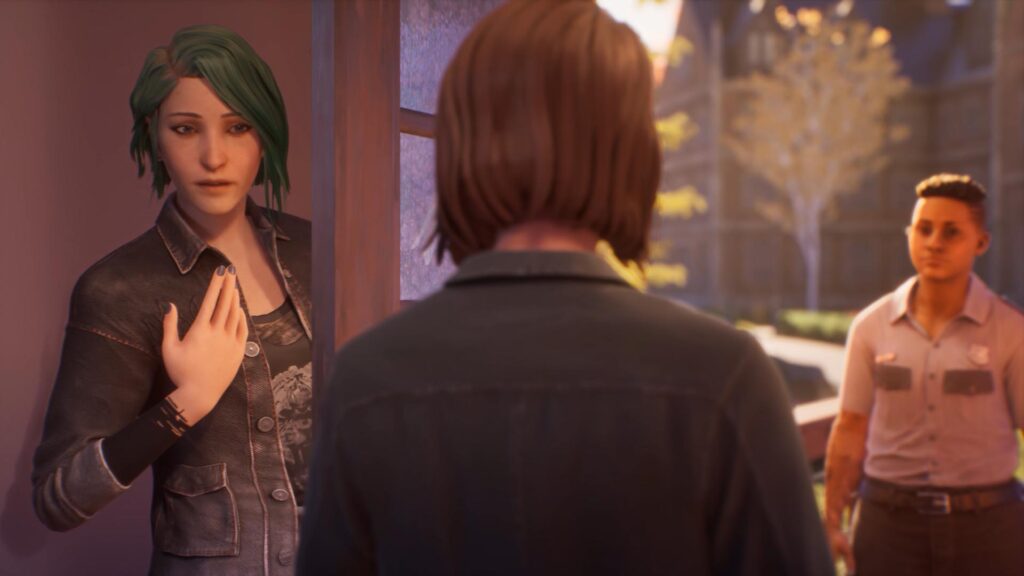
The latest hands-on intel suggests that Life Is Strange: Reunion isn’t just upscaling textures and calling it a day. The team is actively tuning what can only be described as the game’s emotional physics:
- Re-engineered scenes: Key sequences from the original run have been re-blocked, re-lit, or re-edited to land harder in 2026, both visually and emotionally.
- Modernized visuals: Updated character models and environments are less about spectacle and more about micro-expression fidelity — crucial for a story that lives and dies on eye contact and hesitation.
- Continuity payloads: Narrative stitching appears designed to lock this in as the canonical closure op for the Arcadia Bay timeline, reducing ambiguity about where Max and Chloe’s arc truly ends.
From a systems standpoint, this implies a re-pass on timing, pacing, and camera language, all feeding into that recalibrated choice-impact matrix. The promise is “maximal narrative volatility” on launch: your decisions should feel like they carry more kinetic energy than in any prior entry.
Strategic Takeaways for Devs and Players
For players, Life Is Strange: Reunion isn’t just nostalgia deployment — it’s a chance to rewrite your final say on Max and Chloe with higher-fidelity tools. For developers tracking this from the #gamedev trenches, Reunion reads like a live lab on:
- How to revisit legacy IP without collapsing into a simple remaster.
- How to architect final-choice-heavy design, where the last act does the heaviest narrative lifting.
- How dual-timeline structures can be tuned so that inter-protagonist synchronization drives both plot and player emotion.
As March 26 approaches, the signal is clear: Life Is Strange: Reunion wants your last decision not just to end the story — but to define what the Arcadia Bay saga ultimately means.
Sources and corrections
This archive entry does not have a verified article-source list. Images and video embeds alone are not evidence for every claim.
Found an error? Request a correction. Include the passage and a supporting source.
Your games, in one place
Keep up with Life Is Strange: Reunion
Follow this game to collect its posts in your personal feed. Come back to see what you missed.