Automated archive / Jay and Silent Bob: Chronic Blunt Punch
Jay and Silent Bob: Chronic Blunt Punch Comes Out Swinging
Jay and Silent Bob: Chronic Blunt Punch has officially left the haze of long-term development and launched as a hand-drawn, tag-team co-op brawler rooted in Kevin Smith’s View Askewniverse. Interabang Entertainment is betting that precise 2D combat, dense fan-service, and integrated narrative banter can turn a...
AI-generated summary. This archive article does not have a current recorded source check. Check linked sources before relying on details. Editorial policy

Sector Snapshot: Chronic Blunt Punch Exits the Smoke, Enters the Market
Jay and Silent Bob: Chronic Blunt Punch has officially transitioned from long-smoldering prototype to fully deployed side-scrolling brawler, and the last week’s signal traffic confirms one thing: Interabang Entertainment didn’t just ship a meme game. They’ve pushed a tightly framed 2D co-op brawler that leans hard into Kevin Smith’s View Askewniverse while still chasing arcade-grade combat depth.
Over the last seven days, activity feeds flagged three major beats: confirmation that development has re-entered a fully active state, the public deployment of launch trailers, and renewed messaging focused on tag-team combos, co-op play, and fan-service density. For #gamedev teams tracking licensed IP brawlers and #indiegame pipelines, Chronic Blunt Punch is now a live case study in how to weaponize cult cinema into a mechanically coherent, side-scrolling fighter.
From Dormant Concept to Active Development Theater
Reactivating a Long-Term Project
The “Side-Scrolling Stoner Ops” update signals that Chronic Blunt Punch has re-entered an active development field after a protracted, smoke-filled incubation. Interabang is now openly tuning narrative banter, co-op systems, and console deployment specifics — a reminder that long-tail licensed projects can come back online if the IP, community, and dev stamina align.
Mechanically, the emphasis is on a tag-team, combo-heavy combat loop. This isn’t a loose, button-mashy movie tie-in; the language around “arcade-precise inputs” and “combo-heavy 2D brawler” suggests a deliberate attempt to court players who expect readable frame data, responsive hitboxes, and layered move sets beneath the cartoon absurdity.
Narrative Banter as a First-Class System
Chronic Blunt Punch is leaning into Jay and Silent Bob’s trademark verbal chaos as a design pillar, not just background noise. The activity feed repeatedly highlights “narrative banter” and “meta-humor” — meaning VO, timing, and dialogue pacing are likely interwoven with combat beats, not simply relegated to cutscenes.
For developers, this is an instructive pattern: when your IP is built on dialogue, integrating banter into gameplay flow (co-op callouts, tag-in quips, contextual taunts) is a better retention strategy than dumping jokes into pre-fight cinematics. It also raises production complexity: VO pipelines, localization, and script iteration all become combat-adjacent systems.
Combat Intelligence: Tag-Team Brawling in the View Askewniverse
Co-op as Core, Not Optional
Both launch transmissions emphasize 2D co-op beatdowns and tag-team combo systems. This positions Chronic Blunt Punch as a couch (or online) co-op first experience, with solo play likely treated as a secondary path. For #gamedev teams, this is a notable design commitment: encounter layouts, enemy clustering, and boss scripting all need to scale for two active players chaining combos.
The phrase “tag-team combos” suggests mechanics closer to a fighting game/brawler hybrid than a pure belt-scroller. Expect:
- Character-swapping in mid-combo for extended juggle routes
- Co-op synergy attacks that reward timing and positioning
- State-based enemy reactions tuned to multi-character pressure
Combined with the hand-drawn art direction, the combat loop aims to blend cartoon ultraviolence with input precision — a risky but potentially rewarding mix for players who want both spectacle and execution.
Environments as Fan-Service Delivery Systems
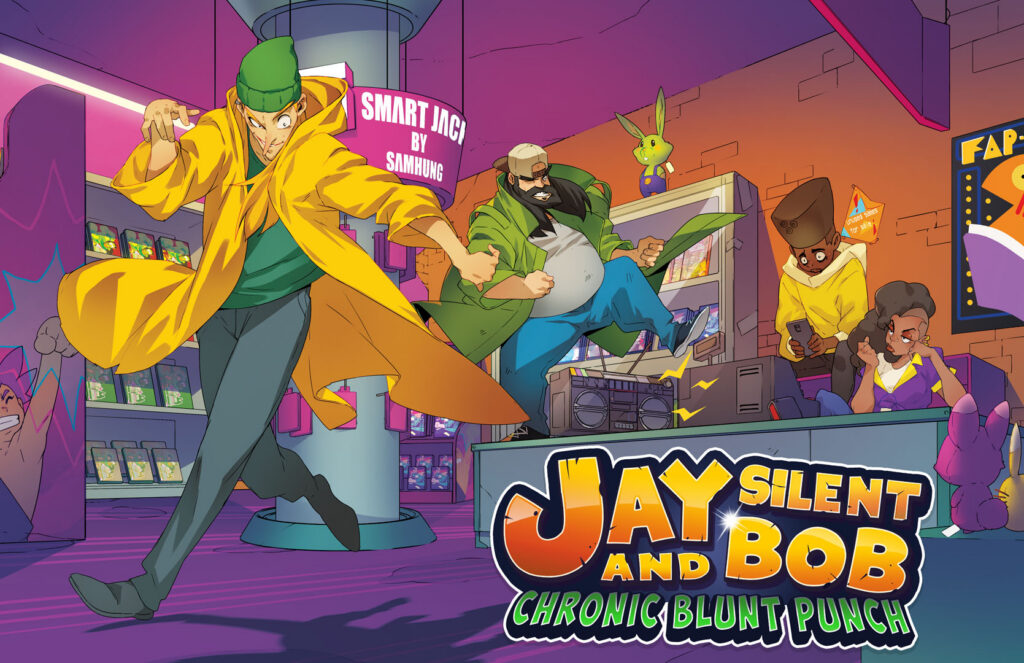
The activity feed calls out malls, alleys, convenience-store chaos, and “multiverse side-channels.” That’s not just set dressing; it’s a content strategy. Chronic Blunt Punch is clearly structured as a tour through the View Askewniverse, using familiar locations as anchors for gags, cameos, and boss encounters.
For licensed #indiegame teams, this is the playbook: design stages as thematic hubs where mechanical escalation (new enemy types, hazards, and combat modifiers) piggybacks on recognizable IP landmarks. The “dense fan-service references deployed at high frequency” line underscores that Interabang is deliberately saturating the experience with callbacks to keep cult-film fans engaged between fights.
Market Positioning: Loud-Mouthed, Hand-Drawn, and Niche-Precise
Targeting the Cult-Film Neural Archive
The messaging is unapologetically tuned to Kevin Smith’s existing fanbase. Terms like “meta-humor aimed straight at cult-film neural archives” signal that Chronic Blunt Punch isn’t chasing four-quadrant mainstream appeal; it’s doubling down on the people who can quote Clerks, Mallrats, and Dogma from memory.
That said, the combat-first framing and co-op focus widen the potential audience beyond pure nostalgia. If the tag-team mechanics and difficulty tuning land, the game could occupy a similar niche to other modern retro brawlers — but with a sharper, more aggressively referential script.
Visual Identity and Platform Readiness
Hand-drawn character work and exaggerated animation sell the “cartoon ultraviolence” angle, which pairs well with the IP’s profanity-laced humor. This art direction also lowers the uncanny-valley risk that often plagues licensed adaptations of live-action actors.
With console deployment in focus, Interabang will be judged on performance stability, input latency, and co-op netcode (if online play is present). For a game leaning on tight combos and tag-team coordination, even minor hitches can undercut the entire fantasy.
Strategic Takeaways for Devs Tracking Licensed Brawlers
-
IP-First, System-Second Can Work — If Systems Are Respected
Chronic Blunt Punch is clearly IP-forward, but the repeated emphasis on “arcade-precise inputs” and combo systems shows that Interabang knows fan-service alone can’t sustain engagement. -
Dialogue-Driven Properties Need Integrated Banter Systems
Treating narrative banter as a core loop element — not just cutscene filler — is a key differentiator here and a lesson for future adaptations. -
Co-op as a Design Spine, Not a Mode
Building encounters and bosses around two-player synergy from the ground up is more compelling than tacking on a second controller option at the end of development.
As of this week, jay and silent bob: chronic blunt punch has fully entered the market as a loud-mouthed, hand-drawn co-op brawler. For developers watching the licensed IP beat ’em up space, this launch is a live-fire test of whether cult cinema, cartoon absurdity, and mechanically ambitious 2D combat can coexist in a single, smoke-wreathed package.
Sources and corrections
This archive entry does not have a verified article-source list. Images and video embeds alone are not evidence for every claim.
Found an error? Request a correction. Include the passage and a supporting source.
Your games, in one place
Keep up with Jay and Silent Bob: Chronic Blunt Punch
Follow this game to collect its posts in your personal feed. Come back to see what you missed.