
Back to guides and news
Gaming
April 23, 2026
Sector Intelligence Report: Jay and Silent Bob: Chronic Blunt Punch Reenters the Brawler Grid and Fully Deploys
Official key art transmission from the front lines of the View Askewniverse
Operational Overview: Chronic Blunt Punch Fully Deployed
Jay and Silent Bob: Chronic Blunt Punch has officially moved from long-smoldering prototype to live deployment, marking a major inflection point for both Interabang Entertainment and licensed 2D brawlers in the #indiegame space. After years of sporadic signals, the last week’s activity confirms two key realities: the project is back in active development refinement and the full launch build is in the field, targeting console and likely PC ecosystems.
At its core, jay and silent bob: chronic blunt punch is a hand-drawn, side-scrolling co-op brawler that fuses arcade-precise inputs with Kevin Smith’s cult-film banter and multiverse weirdness. From a #gamedev perspective, this is a high-risk, high-reward hybrid: a mechanically dense, tag-team combo fighter wrapped in aggressively referential comedy that must land for both genre fans and View Askew diehards.
Tag-Team Systems and Co-op Design
Combo-Heavy, Two-Character Spec
The intel feed repeatedly flags a tag-team combo system as a pillar feature. Rather than simple drop-in co-op, Interabang appears to be designing around:
- Active character swapping between Jay and Silent Bob mid-combo
- Synergy chains where one character’s launcher or stun sets up the other’s finisher
- Co-op specific routes, rewarding coordinated play with higher damage and crowd control
For #gamedev teams tracking combat design, this positions Chronic Blunt Punch closer to a Marvel vs. Capcom-inspired rhythm than a pure button-mashy belt brawler. The key risk is input readability: the studio must balance spectacle with frame clarity so players can reliably parse hit confirms, cancels, and crowd states.
Couch Co-op as a Primary Use Case
The feed emphasizes 2D co-op beatdowns and “controller readiness,” strongly suggesting that local co-op is a primary focus, not an afterthought. That implies:
- UI and HUD tuned for two players sharing a single screen, with clear health, meter, and tag indicators
- Enemy wave composition that scales for solo vs. co-op runs
- Possibly assist or revive mechanics to keep both players engaged during longer encounters
This is a strategic alignment with the IP itself—Jay and Silent Bob are functionally inseparable, so the mechanics doubling down on duo play is both thematic and systemic design coherence.
Narrative Payload: Banter, Fan Service, and Meta-Humor
The report calls out “narrative banter, fan-service cameos, and meta-humor” as active tuning targets. That suggests Interabang is not treating story as a thin wrapper, but as a constant foreground presence during combat and traversal.
Key takeaways:
- High-density references: malls, alleys, convenience-store chaos, multiverse channels—these are all canonical touchpoints for Kevin Smith’s filmography.
- In-fight chatter: Expect VO quips and reactive lines that trigger off enemy types, locations, or combo milestones.
- Cameo-driven pacing: Boss encounters and mid-level events will likely be built around recognizable characters or parodies, effectively turning each stage into a fan-service vignette.
From a production standpoint, this demands tight scripting and VO integration. Overloading the soundscape with jokes risks fatigue; underdelivering risks the game feeling disconnected from the IP. The sweet spot is reactive, context-aware humor that doesn’t drown out combat clarity.
Visual and Level Design: Hand-Drawn Cartoon Ultraviolence
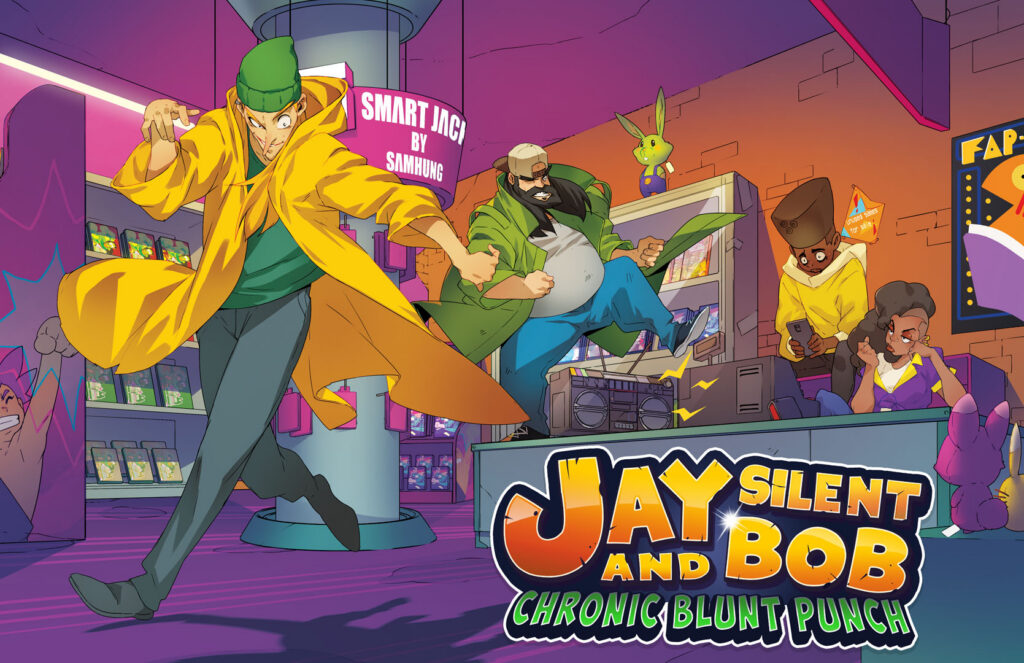
Keyframe capture: Hand-drawn combo chaos in Jay and Silent Bob: Chronic Blunt Punch
The activity feed frames the game as “cartoon ultraviolence” with hand-drawn visuals and a tour through malls, alleys, and multiverse side-channels. For #indiegame pipelines, this implies:
- A 2D animation stack reliant on bespoke keyframes rather than skeletal rigs, trading raw throughput for expressive character motion.
- Levels built around recognizable, mundane spaces (malls, convenience stores) exaggerated into surreal arenas, a hallmark of Smith’s comedy.
- A color and effects language that must keep hitboxes legible even as the screen fills with parodies, props, and VFX.
The hand-drawn approach is a strong differentiator in a crowded brawler field, but it increases iteration cost. The mention of “reenters active development field” suggests the team is continuing to tune animation timing, hit reactions, and readability even after launch—an increasingly standard approach in live-tuned single-player and co-op titles.
Post-Launch Reality: Active Development After Deployment
The most notable signal in this week’s intel is that Interabang Entertainment has reactivated long-term development on Chronic Blunt Punch while the game is already live. In practice, that likely manifests as:
- Balance passes on enemy HP, stun thresholds, and combo scaling based on early player data.
- Co-op tuning, including difficulty curves, revive windows, and enemy spawn logic for two-player runs.
- Content and cameo adjustments, potentially adding or refining fan-service beats in response to community sentiment.
For other #gamedev teams working with licensed IP, this is a useful case study: a cult-property brawler that doesn’t treat launch as the finish line, but as the start of a live refinement window.
Strategic Takeaways for Developers Tracking Licensed Brawlers
For studios eyeing licensed beat ’em ups, Jay and Silent Bob: Chronic Blunt Punch offers several actionable insights:
1. Mechanically Respect the Genre
Instead of relying solely on IP recognition, Interabang has committed to tag-team, combo-heavy combat that must stand up to genre expectations. Licensed games that lean into mechanical depth tend to have longer tails and stronger word-of-mouth.
2. Align Co-op With Character Identity
Building systems that reflect the duo identity of Jay and Silent Bob (tag mechanics, synergy combos, co-op-first tuning) is a textbook example of ludonarrative alignment—gameplay and character concept reinforcing each other.
3. Treat Humor as a System, Not a Skin
By integrating banter, cameos, and meta-humor into level flow and encounter design, the comedy becomes a systemic layer, not just surface dressing. That’s critical when adapting any comedy-forward IP to interactive form.
Final Status: Controllers on Standby
With jay and silent bob: chronic blunt punch now fully deployed and active development confirmed, the next quarter will reveal whether Interabang’s blend of co-op tag-team combat, dense fan-service, and hand-drawn spectacle can secure a durable foothold in the 2D brawler ecosystem. For #gamedev observers and licensed-IP strategists alike, this is one beat ’em up worth tracking frame-by-frame.
Keep following Jay and Silent Bob: Chronic Blunt Punch
News, guides, posts, and game details in one place.
Open the game hub, then save it to build your personal Breach feed.
More images and video
About the game
Jay and Silent Bob: Chronic Blunt Punch
Interabang Entertainment
Mission Intelligence: Jay and Silent Bob: Chronic Blunt Punch is a hand-drawn 2D co-op beat ’em up where the View Askewniverse goes full arcade brawler. Players chain tag-team combos, supers, and crowd control moves while bantering through story-driven stages and boss encounters. Expect classic mall mayhem, meme-ready dialog, and tight controller-first combat. Ideal for fans searching for retro beat ’em up gameplay fused with Kevin Smith’s cult comedy universe.
Open game pageTopics
Jay and Silent Bob: Chronic Blunt Punch
jay and silent bob game
2D co-op brawler
licensed beat em up
Interabang Entertainment
Kevin Smith game
hand-drawn side-scroller
#gamedev
#indiegame
tag-team combo system
co-op game design
View Askewniverse game