Back to guides and news
Gaming
April 23, 2026
Sector Intelligence: Forza Horizon 6 Locks In 500K PC Presales as Tokyo Biome and Pro-Grade Hardware Come Online
Sector Overview: Forza Horizon 6 Enters Pre-Launch Overdrive
Forza Horizon 6 just pushed its pre-launch telemetry into the redline: over 500,000 pre-sold copies on Steam with a full month still on the countdown clock. For a series historically anchored to the Xbox ecosystem, that data spike is a decisive signal that PC demand for open-world racing sandboxes remains aggressively strong. For #gamedev teams watching the sector, Horizon’s latest run confirms that premium racing worlds still command serious bandwidth when you combine established IP, reliable tech pipelines, and clear platform messaging.
The last seven days of activity around forza horizon 6 have crystallized three major vectors: explosive PC pre-sales, a targeted hardware ecosystem drop, and the first deep dive into the Tokyo City biome. Together, they sketch a clear picture of how Playground Games and Xbox are engineering this launch: not as a one-off racer, but as a long-tail live service platform where input fidelity, visual identity, and biome density are all part of the same design thesis.
500K Steam Presales: What the Numbers Signal to Developers
With 500,000 pre-sold copies on Steam alone, forza horizon 6 is already operating at a scale many AAA launches only hit post-release. For developers, that’s a concrete market proof point:
1. Open-World Racing Still Prints Demand
The genre narrative for years has been that racing is niche compared to shooters and RPGs. Yet Horizon 6’s pre-sale packet suggests that when you deliver a frictionless open-world structure, strong car culture fantasy, and consistent technical execution, players will commit early. This is especially instructive for #indiegame studios flirting with smaller-scale driving or stunt projects: the fantasy of freedom and speed in a coherent world still sells, even if you don’t have 600 cars and licensed soundtracks.
2. PC as a First-Class Racing Platform
The Steam performance underscores that PC is no longer a secondary racing audience. High refresh displays, wheel setups, and sim-adjacent communities are converging around titles that balance arcade accessibility with sim-adjacent tuning. Forza Horizon 6 is clearly positioned to harvest that overlap.
From a #gamedev perspective, this should influence how you architect your pipeline:
- Treat PC performance and input support (wheel, pad, KBM) as design pillars, not ports.
- Plan your network and matchmaking layers assuming a heavy PC concurrency spike at launch.
- Build telemetry hooks to understand how PC players actually drive, tune, and churn.
Tokyo City Biome: Verticality, Wet Asphalt, and Controlled Chaos
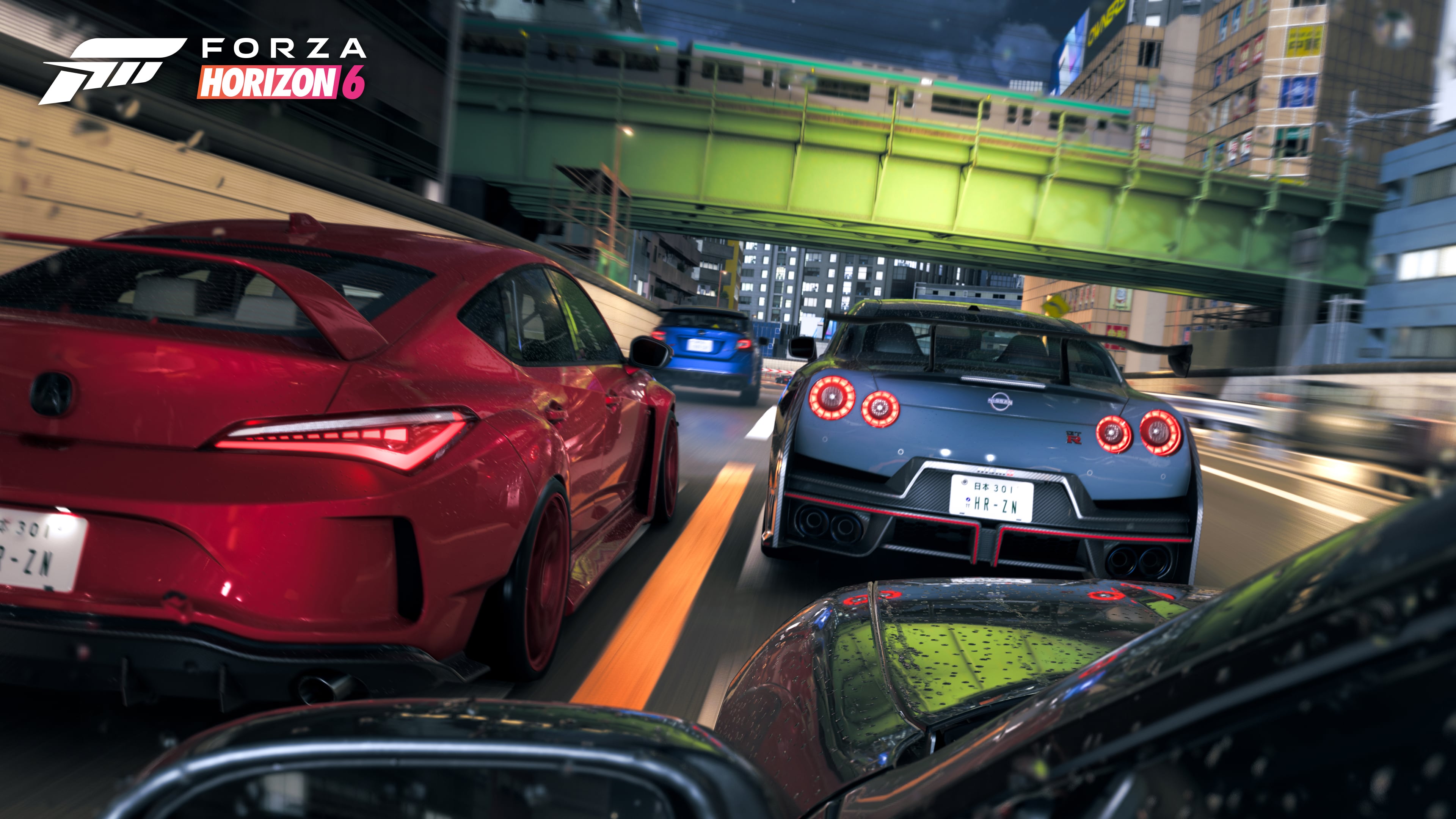
Night expressway sprint through Tokyo City biome
Playground Games’ latest transmission—the Tokyo City biome showcase—reveals the most aggressive urban design the series has attempted so far. This isn’t a wide-open festival plain; it’s a vertical steel canyon tuned for high-speed risk.
1. Biome as Systems Testbed
The Tokyo biome is built as a dense systems lab:
- Elevation shifts force players to constantly re-evaluate braking points and sightlines.
- Expressway sweepers and multi-lane straights are ideal for hypercar sprints and slipstream battles.
- Tight alleyways push collision systems, AI pathing, and camera behavior to their limits.
- Wet asphalt and neon reflections stress-test lighting, materials, and visibility at speed.
For developers, the takeaway is that a biome can be more than a visual theme—it’s a mechanical thesis. Tokyo looks like it’s been engineered as a controlled chaos simulator, where every surface and curve is a data point for how players handle risk, speed, and visibility. Smaller teams can adopt a similar approach: design one high-density environment that intentionally stress-tests your physics, AI, and camera systems instead of spreading effort across too many biomes.
2. Visual Language and Player Readability
Neon signage, reflective puddles, and dense vertical structures can easily become visual noise at 200+ mph. The footage suggests Playground is using strong color contrast, lane lighting, and horizon markers to maintain player readability. That’s a crucial #gamedev lesson: spectacle is only successful if players can parse it at full velocity.
Hardware Ecosystem: Telemetry-Grade Controller and Headset
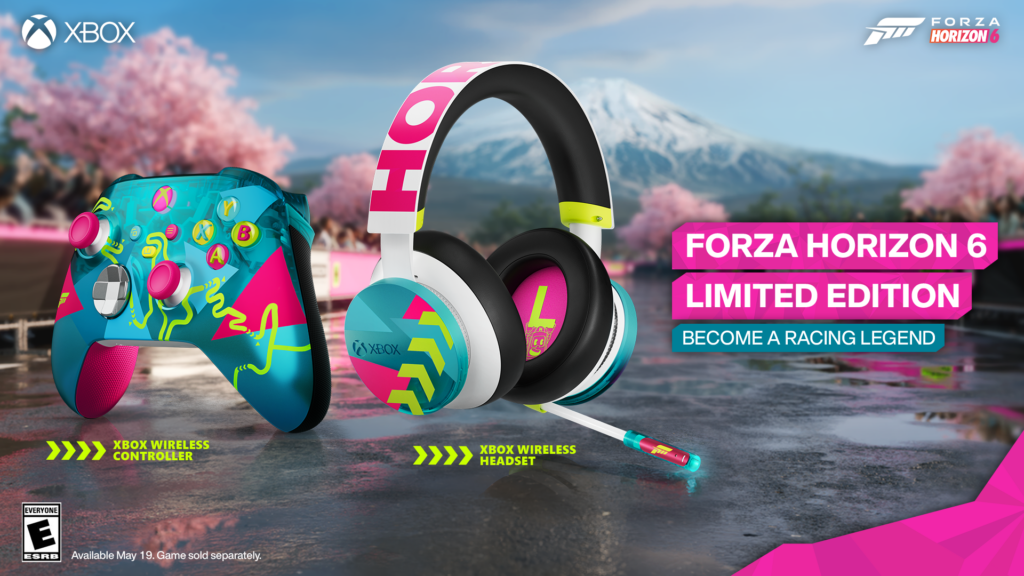
In parallel with the biome reveal and sales spike, Xbox has deployed a Forza Horizon 6 Limited Edition controller and headset—positioned not just as cosmetics, but as performance-oriented racing tools.
1. Input as Part of the Design Loop
The messaging emphasizes haptic fidelity, high-speed visual tracking, and spatial audio tuned for 200+ mph racing. That implies a tight loop between the game’s design team and hardware engineers:
- Haptics can be mapped to traction loss, gear shifts, and surface changes, giving drivers more non-visual feedback.
- Spatial audio is critical in dense urban spaces like Tokyo, where engine echoes, traffic, and environmental cues inform player decision-making.
For #indiegame and mid-tier studios, you probably won’t ship custom hardware—but you can still design with hardware in mind:
- Expose granular vibration and audio options so players can tune their own “telemetry layer.”
- Think about how controller rumble, trigger resistance (where available), and audio mixing can reduce UI clutter by conveying information physically and sonically.
2. Brand Cohesion Across Touchpoints
The neon gradients and horizon-flare detailing on the controller/headset echo the Tokyo biome’s visual identity. This is a full-stack brand play: the way you hold the game, hear the game, and see the game are all synchronized. For teams building their own IP, that’s a subtle but powerful lesson—unifying your visual language across UI, marketing, and even peripherals amplifies recall and desirability.
Strategic Takeaways for Developers
Forza Horizon 6’s latest week of activity isn’t just a marketing beat; it’s a sector-wide case study in how to stage a high-impact launch:
- Front-load trust with PC players. Strong Steam pre-sales for forza horizon 6 prove that if you communicate specs, input support, and performance expectations clearly, PC audiences will commit early.
- Design biomes as mechanical statements. Tokyo City isn’t just a backdrop—it’s a systems testbed. Even small teams can build one deeply tuned environment that showcases their mechanics instead of spreading thin.
- Treat hardware as UX, not just accessories. Whether you’re integrating wheel support or fine-tuning controller rumble, input devices are part of your core design, not an afterthought.
As the countdown to launch continues, expect more telemetry from Playground Games on progression systems, online structure, and post-launch content. For now, the signal is clear: the Horizon festival is about to open its gates again, and the market is already lined up at the entrance.
Keep following Forza Horizon 6
News, guides, posts, and game details in one place.
Open the game hub, then save it to build your personal Breach feed.
More images and video


About the game
Forza Horizon 6
Playground Games
Mission Intelligence: Forza Horizon 6 deploys its open-world festival into Japan, fusing dense urban networks with high-altitude touge routes and coastal straights. Operators can expect advanced weather, wet surfaces, and variable road widths designed to stress-test racing lines and braking discipline. The environment acts as both track and weapon, rewarding precise control and high-speed risk-taking. Ideal for players seeking next-gen open-world racing, drifting, and car culture immersion.
Open game pageTopics
Forza Horizon 6
Forza Horizon 6 Tokyo City biome
Forza Horizon 6 Steam preorders
Forza Horizon 6 Limited Edition controller
Forza Horizon 6 headset
open-world racing game design
racing game PC performance
game development analysis
#gamedev
#indiegame