Sector Intelligence: Final Fantasy VII Rebirth Breaks Platform Containment, Recasts Sephiroth, and Gamifies Junon’s War Parade
Official sector header art – FINAL FANTASY VII REBIRTH key art
Sector Overview: Rebirth Enters Multi‑Platform Theater
- Confirmed cross‑platform expansion beyond PS5 to Nintendo Switch 2 and Xbox.
- Pushed a fresh launch trailer that reframes the project as a full‑scale reimagining rather than a conservative remaster.
- Triggered a voice pipeline realignment for Sephiroth, rotating out George Newbern and onboarding a new vocal lead.
- Turned Junon’s military parade into a tightly designed tactical puzzle—part spectacle, part systems showcase.
Cross‑Platform Deployment: Rebirth Leaves the PS5 Safe Zone
Strategic Expansion to Switch 2 and Xbox
- Extended Revenue Tail: Moving to Switch 2 and Xbox extends the monetization runway well beyond the original PS5 window.
- Tech Stack Stress Test: Rebirth’s hybrid real‑time/ATB combat, large streaming regions, and cinematic density will pressure‑test Square Enix’s internal engine tech on divergent architectures.
- Brand Fortification: Bringing a flagship like Rebirth to more platforms reinforces Final Fantasy VII as a cross‑generation, cross‑ecosystem pillar rather than a single‑platform prestige piece.
Rendering Showdown: Switch 2 vs PC as a Case Study
- Reduced shadow quality, geometry complexity, and effects density on Switch 2.
- Heavy reliance on reconstruction tech—DLSS‑like upscaling or proprietary equivalents—to maintain the illusion of parity.
- Aggressive LOD management and texture streaming to keep performance stable.
Narrative Pipeline Shift: Sephiroth’s Voice Recast
- Brand Risk Management: Sephiroth is a core brand vector; altering his voice risks fan whiplash. Square Enix is betting that performance direction, writing, and sound mix can buffer the transition.
- Pipeline Flexibility: Swapping a flagship VO actor mid‑initiative shows confidence in modular audio pipelines—session management, localization sync, and performance capture must all be robust enough to absorb the change.
- Community Telemetry: Early fan response is mixed, but structurally the FF7 Remake campaign remains intact. For studios, this underscores the importance of monitoring sentiment while staying committed to long‑term creative and contractual realities.
Systems Design Spotlight: Junon Parade as Tactical Puzzle
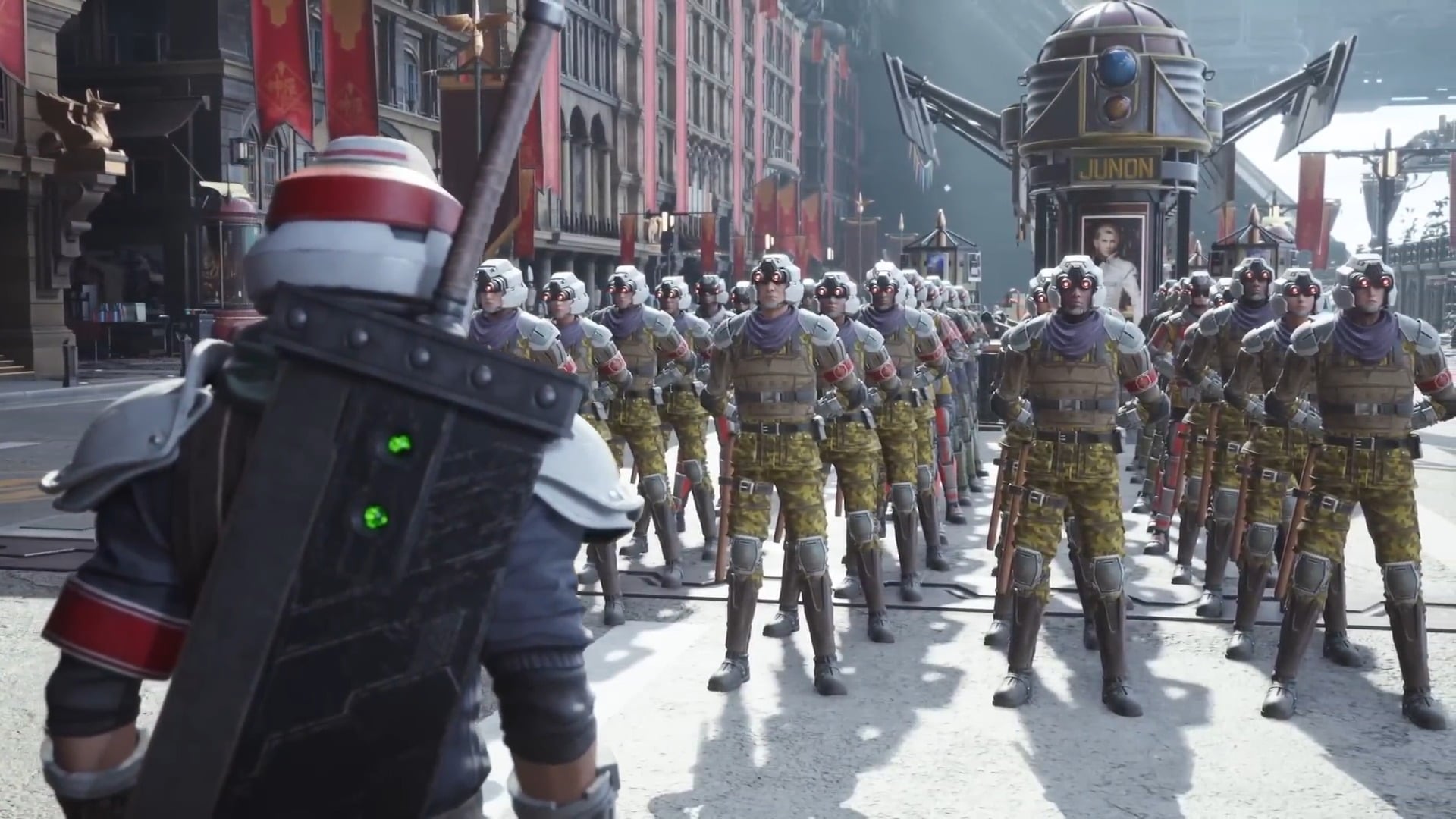
Junon Parade formation drill – Shinra soldier grid in FINAL FANTASY VII REBIRTH
- Diegetic UI & Onboarding: The system teaches formation management, spatial awareness, and crowd control without breaking the fiction of a military parade.
- Replayable Optimization Loop: By tying performance rank to rewards, the parade becomes a light, replayable optimization puzzle—encouraging players to iterate on formations rather than passively watch a cutscene.
- Scalable Complexity: The underlying design—unit tagging, slot assignment, formation scoring—can be scaled up or down for future encounters, making this more than a one‑off gimmick.
Closing Sector Notes
News, guides, posts, and game details in one place.
Open the game hub, then save it to build your personal Breach feed.
More images and video
FINAL FANTASY VII REBIRTH
Final Fantasy VII Rebirth, an epic JRPG developed by Square Enix, smashes open the boundaries of its predecessor, propelling players deep into a reimagined world built on the Unreal Engine 5. The saga continues as Cloud Strife and his iconic crew break free from the confines of Midgar into expansive, open zones filled with narrative twists and new exploration dynamics. Harness the power of overhauled combat systems combined with cinematic storytelling and immerse yourself in a universe teeming with unexpected story divergences, offering both nostalgia and innovation. With its release on Xbox, prepare for a tactical engagement that marries cutting-edge design with the venerable legacy of a classic.
Open game page