Automated archive / DOOM: The Dark Ages
DOOM: The Dark Ages – Nightmare Telemetry, Chain-Spear Glitch, and the ‘Revelations’ War-Puzzle Meta
Nightmare difficulty in DOOM: The Dark Ages isn’t random chaos—it’s a tightly wound attrition engine built on target priority, cooldown cycling, and tactical routing. This week’s intel also flags a critical Chain Spear UI glitch and uses the Revelations drop to map out id’s evolving war‑puzzle design philosophy.
AI-generated summary. This archive article does not have a current recorded source check. Check linked sources before relying on details. Editorial policy

Sector Briefing: A Pre‑Industrial War Machine Tuned for Systems Mastery
DOOM: The Dark Ages is settling into a clear identity: not just a throwback to medieval metal album covers, but a tightly engineered combat simulator where every arena is a solvable war puzzle. Over the last week, the “Revelations” drop and new late‑game footage have reframed expectations for both players and #gamedev teams watching id Software’s systemic design in motion.
The field intel paints a consistent picture: this isn’t chaos for chaos’ sake. DOOM: The Dark Ages on higher difficulties—especially Nightmare—is operating as a sustained attrition test built on resource calculus, positional play, and ruthless target triage. For developers, it’s a live case study in how to push mechanical complexity without drowning players in unreadable noise.
Ballistic Systems: The First 20 Minutes as a Design Manifesto
The first 20 minutes of DOOM: The Dark Ages, as surfaced in this week’s activity feed, function like a thesis statement for the entire campaign.
1. Shield‑Saw Ballistics and the New Baseline
The shield‑saw isn’t just a gimmick; it’s a core verb in the combat grammar. Early encounters already demand:
- Angle discipline – ricochet lines and shield throws that pre‑clear space before the player commits to a push.
- Tempo control – alternating between ranged shield pressure and brutal close‑quarters executions to keep resources cycling.
For #gamedev observers, this shows a deliberate move away from pure hitscan or projectile dodging toward predictive play: players are incentivized to draw mental lines through the arena and fight along those trajectories.
2. Arena Verticality as a Pacing Lever
The early arenas in Revelations don’t just stack vertical layers for spectacle; they’re used as pacing valves. Enemy density is tuned so that:
- Climbing or dropping a level isn’t escape—it’s a trade of threat profiles.
- Movement routes feel like tactical rotations rather than panic dashes.
This is encounter design that reads closer to a hero-shooter lane rotation than classic corridor shooter flow, something #indiegame teams can study when building compact but replayable combat spaces.
Nightmare Telemetry: Attrition, Not Randomness
The late‑game Nightmare gameplay circulating this week confirms what the opening suggests: DOOM: The Dark Ages is a sustained attrition model rather than a chaos simulator.
Key takeaways from the telemetry:
- One mistake is rarely isolated. A missed cooldown, a misrouted dash, or a failed execution often cascades into a full wipe 10–15 seconds later.
- Target priority is the real difficulty curve. Demons are placed to force constant reprioritization: control units, pressure units, and execution fodder all interplay in tight timing windows.
- Cooldown cycling is the invisible skill check. The real “DPS check” is how efficiently players rotate abilities, grenades, and mobility tools while staying on optimal targets.
From a design standpoint, this is id doubling down on a systems mastery model. Difficulty isn’t just about higher damage numbers; it’s about compressing decision time while expanding the number of viable decisions. For designers tuning their own combat loops, Doom: The Dark Ages becomes a reference point for how to scale depth without introducing opaque mechanics.
Chain-Spear Protocol: When UI Glitches Undercut Combat Literacy
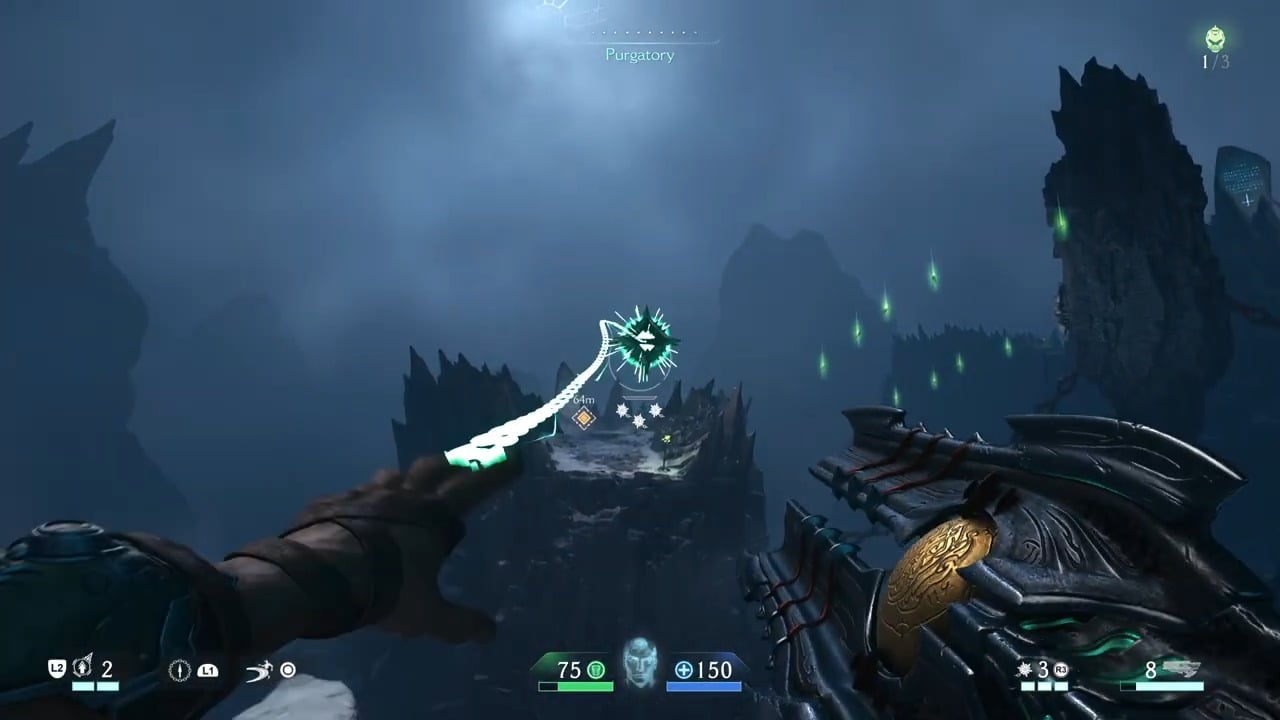
Not all this week’s intel was about high-level mastery. A very grounded issue surfaced: the missing Chain Spear Throw button prompt.
Operators reported that the Chain Spear’s throw input occasionally disappears from the HUD, leaving players to guess the correct bind mid‑fight. The community‑level workaround—manually rebinding controls in settings to force the prompt back into visibility—highlights a critical lesson for #gamedev teams:
- Combat literacy is UI‑dependent. When a core tool like the Chain Spear loses its on‑screen affordance, the entire combat loop suffers. Players can’t properly integrate the spear into their decision tree.
- Input feedback is part of balance. A perfectly tuned weapon is effectively nerfed if the player can’t reliably see how or when to use it.
For Doom: The Dark Ages, this bug is a minor but important reminder: in a game where every tool has a designed niche in the war puzzle, losing a single prompt distorts the intended meta. Expect an official patch to normalize this soon; until then, logging the manual fix into your “kill‑routine” is essential.
Revelations Online: Live Systems Brief for the Campaign Meta
The official Revelations packet going live this week effectively acts as a public design document in motion. Between the trailers and gameplay segments, you can trace id’s priorities:
- A pre‑industrial fantasy wrapper that disguises a deeply modern systems shooter.
- Larger, siege‑scale demons that function as moving objectives rather than simple bullet sponges.
- A focus on encounter readability despite dense visual noise—clear silhouettes, telegraphed attacks, and strong audio cues.
For #indiegame and AA studios, Doom: The Dark Ages offers a blueprint in how to scale spectacle while maintaining mechanical clarity. For players, it’s a promise: mastery will be earned, not handed out.
Strategic Outlook: What This Week Signals for Launch and Beyond
This week’s activity crystallizes three strategic points around Doom: The Dark Ages:
- Nightmare is the purest form of id’s intent. If you want to understand how the systems interlock, study late‑game Nightmare runs; that’s where the design assumptions are fully exposed.
- The combat loop is a war puzzle, not a power fantasy treadmill. You’re not just stronger; you’re more fluent in the game’s internal logic. That’s a crucial distinction for anyone analyzing retention and replayability.
- Small UX fractures can ripple through the meta. The Chain Spear prompt bug is a cautionary tale: in a systems‑heavy shooter, even a single missing icon can materially change how players approach encounters.
As Revelations continues to broadcast new slices of campaign and systems design, Doom: The Dark Ages is positioning itself as a flagship case study in modern encounter crafting. Whether you’re a Slayer in training or a designer deconstructing every frame, this is one medieval battlefield worth dissecting week after week.
Sources and corrections
This archive entry does not have a verified article-source list. Images and video embeds alone are not evidence for every claim.
Found an error? Request a correction. Include the passage and a supporting source.
Your games, in one place
Keep up with DOOM: The Dark Ages
Follow this game to collect its posts in your personal feed. Come back to see what you missed.