Automated archive / Destiny 2
Sector Intelligence: Guardian Games 2026 Turns Destiny 2 Into a Space Olympics Salt Mine
Guardian Games 2026 has turned Destiny 2’s Tower into a full-blown competitive staging zone, backed by a sharp Magic: The Gathering crossover and a data-minded 9.5.6 balance pass. This week’s operations show how Bungie is weaponizing ritual events, cosmetics, and telemetry to keep its live-service machine humming.
AI-generated summary. This archive article does not have a current recorded source check. Check linked sources before relying on details. Editorial policy
Tower Situation Report: Guardian Games 2026 Goes Fully Competitive
Guardian Games 2026 has flipped Destiny 2’s social hub into a live-service coliseum. The Tower is now a scoreboard arena where Titans, Hunters, and Warlocks grind medallions, chase podium placement, and quietly mald over class win rates. Under the banner of Operation: Rushdown, the event is tuned around sustained playlist uptime: you farm medallions in event activities, bank them at the podium, and convert that effort into event-exclusive weapons, cosmetics, and bragging rights that last long after the banners come down.
From a #gamedev and live-ops perspective, this is Bungie doubling down on seasonal ritualization. Guardian Games has evolved from a novelty race into a recurring systems testbed: telemetry, playlist engagement, and reward tuning all funnel through this three-way class war. The framing is playful, but the data it generates is serious business for a game that still has to prove its long-term retention curve.
Operation: Rushdown – Event Design Under the Microscope
Guardian Games 2026’s Rushdown activity is positioned as a high-pressure proving ground, not just a themed strike remix. The language in the field brief—“relentless efficiency checks,” “precision loadout tuning,” “competitive staging zone”—telegraphs Bungie’s intent: this is a ritual event designed to feel closer to a mini-seasonal activity than a one-off playlist.
Key structural beats:
Medallion Economy as Engagement Lever
Medallions remain the core currency, but the brief emphasizes uptime and banking cadence. That’s standard Destiny 2 design, but here it’s being sharpened into a clear loop:
- Run curated event playlists (strikes, possibly core modes with modifiers).
- Generate medallions based on performance and time invested.
- Bank at the Tower podium to advance class score and unlock Guardian Games armaments and holofoil weapon variants.
Those holofoil variants are an especially sharp hook: cosmetic-forward, prestige-coded rewards that don’t break balance but heavily incentivize repeat runs. It’s a classic live-service move—cosmetics as the apex of effort—but framed with enough flair to feel distinct from standard Eververse ornamentation.
Class Supremacy as Social Pressure
The podium race is still the psychological engine of the event. By reclassifying the Tower as a competitive staging zone, Bungie ensures players can’t escape the meta-story: your class is either winning, losing, or coping.
This is social design as soft pressure—if your banner is trailing, you’re nudged to queue more; if you’re ahead, you’re incentivized to defend the lead. For Destiny 2’s designers, it’s a low-friction way to turn passive social spaces into active motivators.
MTG Crossover: Planeswalkers in the Tower
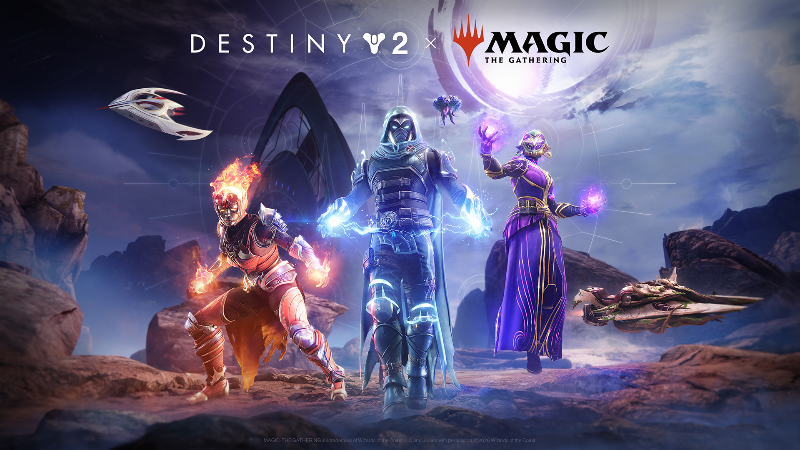
In parallel with Guardian Games, Bungie has executed a Magic: The Gathering crossover that leans hard into full-kit fantasy rather than one-off nods. Each class gets a planeswalker-inspired armor set plus cosmetics tied into the five-color mana schema. The result: a Tower that looks like a cross between a raid lobby and a TCG convention floor.
From a #gamedev and brand-partnership standpoint, this is smart, layered design:
- Aesthetic Coherence: Instead of isolated ornaments, Bungie ships full-style packages. This keeps silhouettes readable in combat while still letting the crossover fantasy breathe.
- Lore-Adjacent, Not Lore-Bound: The brief frames it as “importing planeswalker aesthetics” rather than rewriting Destiny canon. That’s a crucial line for long-term players who are wary of lore whiplash.
- Retention via Collection: MTG’s DNA is collection and deckbuilding; Destiny 2’s is loadouts and fashion. The crossover leans into that overlap, turning armor acquisition into a pseudo-collection meta without bolting on new systems.
For #indiegame developers watching from the sidelines, this is a case study in thematic integration over raw IP flex. The crossover works because it respects both brands’ visual languages while still serving the host game’s readability and UX constraints.
Systems Update: Patch 9.5.6 and Live-Ops Signaling
Patch 9.5.6 lands as a targeted tuning pass rather than a sweeping overhaul, but the messaging around it is the real story. The directive to "review notes before you scream on Reddit" is tongue-in-cheek, yet it underscores a crucial dynamic: Bungie is proactively framing balance changes as data-driven responses rather than reactive nerfs.
Two signals stand out:
Telemetry-Driven Balancing
With Guardian Games funneling players into specific activities and loadouts, this is an ideal window for Bungie’s combat and systems teams to gather dense telemetry: weapon usage, subclass performance, completion times, and failure rates under event pressure. Patch 9.5.6 likely leans on pre-event data, but the live window becomes an ongoing lab.
For developers, this is a reminder that events are not just content—they’re instrumentation opportunities.
Feedback Loop: “Postcards from the Frontier”
The mention of Postcards from the Frontier responses confirms that Bungie is actively acknowledging community feedback in a structured format. Instead of vague “we’re listening” messaging, this suggests a pipeline where:
- Community sentiment → curated responses → visible acknowledgment in official channels.
- Patch notes and event tuning can be read against those postcards as a semi-public roadmap of pain points.
In a market where live-service fatigue is real, transparent feedback loops are as critical as new weapons.
Monetization, Cosmetics, and the Twitch Drop Pipeline
The new Guardian Games emblem being locked behind Twitch drops is a clear signal of where Bungie wants to drive attention. Watch-time gating isn’t new to Destiny 2, but tying it to a marquee event emblem does a few things at once:
- Boosts concurrent viewership on official and partnered streams.
- Extends the event’s footprint beyond the game client into the broader content ecosystem.
- Converts passive fandom into time-on-platform metrics that matter for sponsorships and future partnerships.
Layer in the Oath of the Renegades emblem for Pike loyalists and the MTG-themed cosmetics, and you get a cosmetic economy that’s tightly interwoven with identity, allegiance, and external platforms. It’s not subtle, but it is strategically coherent.
Strategic Takeaways for Developers Watching Destiny 2
For studios studying Destiny 2’s live-ops playbook, this week’s Guardian Games + MTG crossover stack offers several clear lessons:
1. Ritual Events as Data Engines
Guardian Games isn’t just seasonal flavor; it’s a repeatable, instrumented ritual. Every year, Bungie refines the formula, layering in new reward structures and telemetry hooks without overcomplicating the player-facing loop.
2. Crossovers Need Full-Fantasy Commitment
The MTG collaboration works because it commits to full-class fantasy with armor sets and cohesive cosmetics. For #indiegame teams with smaller budgets, the principle still holds: if you do a crossover, make it feel like a complete thought, not a banner ad.
3. Social Spaces as Competitive Surfaces
Reframing the Tower as a competitive staging zone is a subtle but powerful move. Social hubs can carry narrative and competitive weight without becoming mechanically dense. Visuals, banners, and podiums do a lot of heavy lifting for relatively low dev cost.
4. Communication Framed as Field Intel
Styling updates as field briefs and intelligence reports is more than flavor; it’s a framing device that helps players parse what matters week-to-week. For developers, consistent narrative framing around patch cadence can reduce friction and align expectations.
Destiny 2’s latest cycle isn’t reinventing the live-service wheel, but it is sharpening it. Guardian Games 2026, the Magic: The Gathering crossover, and patch 9.5.6 collectively show a mature live-ops team iterating on systems, aesthetics, and communication in lockstep—exactly the kind of coordination the genre increasingly demands.
Sources and corrections
This archive entry does not have a verified article-source list. Images and video embeds alone are not evidence for every claim.
Found an error? Request a correction. Include the passage and a supporting source.
Your games, in one place
Keep up with Destiny 2
Follow this game to collect its posts in your personal feed. Come back to see what you missed.