Automated archive / Denshattack!
Denshattack! Turns Neo-Japan’s Rail Network into a Physics-Driven Combat Puzzle
Denshattack! has fully launched, turning Neo-Japan’s rail network into a brutal, physics-driven score-attack arena where your skateboard is a speeding train. This week’s intel breaks down its rail-surfing movement, collision-centric combat, and why its difficulty curve is tuned for players who treat failure like data.
AI-generated summary. This archive article does not have a current recorded source check. Check linked sources before relying on details. Editorial policy
Situation Overview: Denshattack! Leaves the Prototype Station
Denshattack! has officially left early-prototype territory and rolled into full launch, and it’s not just another stylish #indiegame with trains. The last week of field intel paints a picture of a hybrid rail-combat and skateboarding system that fuses collision choreography, lane management, and trick-style routing into a single, ruthless arcade loop. The aesthetic headline is simple—you’re effectively skateboarding a train through stylized Japan—but the underlying math is closer to a live-fire logistics sim.
Across trailers, first-minutes footage, and a full review pass, a consistent pattern emerges: Denshattack! is built around high-speed decision density. Every second demands timing checks, track reads, and risk calculations. The interface is deceptively clean, but the escalation curve is tuned for players who treat failure as data rather than punishment.
Core Systems: When Your Skateboard is a Train
Rail-Surfing as a Movement Language
Initial recon confirms that Denshattack! treats the train as a physics-driven rail board. You’re not just riding on top of a carriage; you’re effectively piloting a kinetic object along dense urban tracks, with continuous forward momentum as the primary constraint. Movement is lane-based but not simplistic:
- Lane switching functions like a grind transfer in a skate game—high commitment, high reward.
- Momentum management is central; maintaining speed keeps options open, while hesitation narrows your viable routes.
- Trick chaining doesn’t manifest as ollies and kickflips, but as optimized route choices, near-miss threading, and high-value collisions.
This transforms railway topology into a combo puzzle. Instead of memorizing skate lines in a park, you’re memorizing and reacting to branching rail networks under pressure.
Weaponized Railcars and Collision-Oriented Play
The recent launch trailer intelligence frames trains not just as vehicles, but as payload and projectile. You’re orchestrating collisions to maximize score and survive mounting traffic density. Key loop elements:
- Orchestrated crashes: Lining up impact angles on crowded rails to chain destruction and clear space.
- Track control: Choosing which lines to occupy or abandon, effectively “routing” chaos away from your position.
- Timing windows: Tight, unforgiving input windows turn every lane change into a micro-risk.
The review data describes this as “borderline sadistic scheduling math” wrapped in a minimalist interface. That’s a telling #gamedev choice: the UI stays clean so the player can parse dense visual telemetry—signal lights, oncoming trains, junctions—without HUD clutter. The complexity is systemic, not menu-driven.
Difficulty Curve: Iterative Skill Scaling, Not Hand-Holding
From Readable to Ruthless
Early-game telemetry shows runs that are fast yet readable: track layouts are legible, collision opportunities are obvious, and the game teaches its language through repetition rather than explicit tutorials. As players advance, the design pivots hard into pattern recognition stress tests:
- Multi-track threats converge from several directions.
- Decision loops compress; you’re making route calls in fractions of a second.
- Hesitation is punished with unavoidable collisions or dead-end lines.
This is a deliberate stance against over-tutorialization. The team is betting on iterative skill scaling: each failed run becomes more training data for the player’s internal model of how Denshattack! schedules its threats.
Arcade-Tight Loops and Score-Chasing Culture
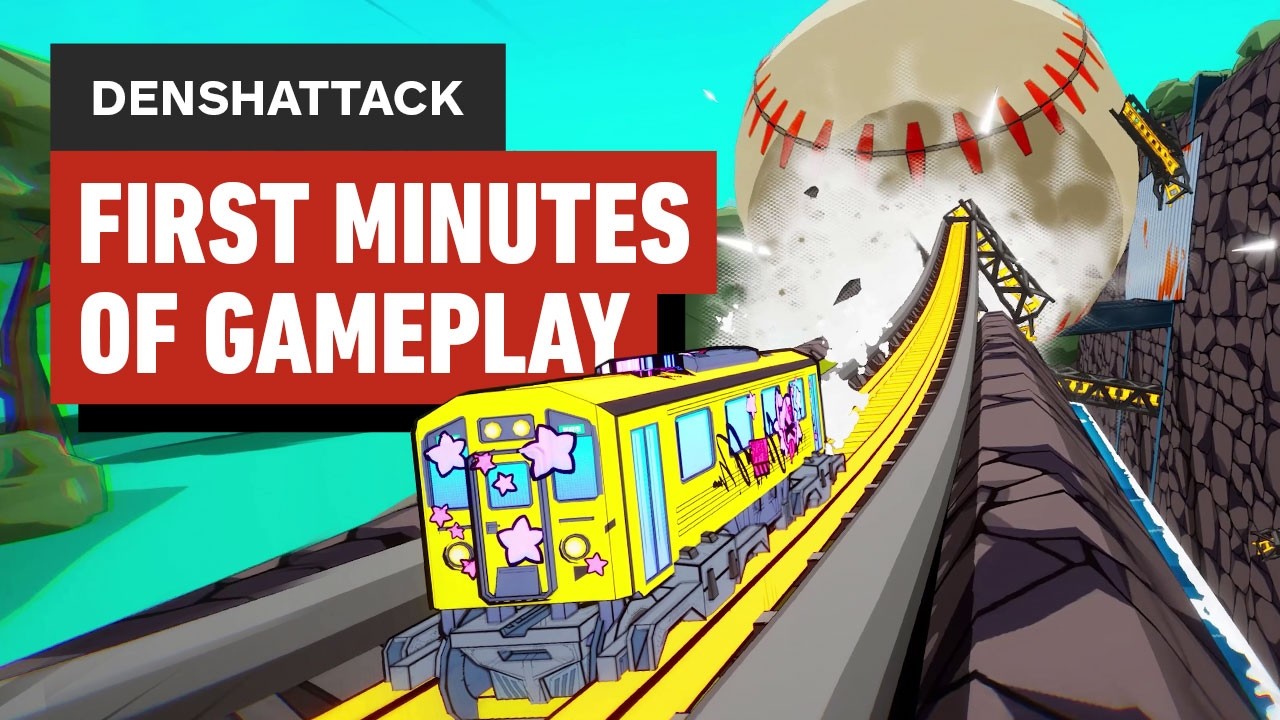
The first-minutes gameplay capture reinforces Denshattack! as a score-chasing arcade machine, not a narrative-forward experience. Core loop characteristics:
- Short, intense runs that encourage immediate retries.
- Leaderboards that reward route optimization and risk-heavy playstyles.
- A feedback structure tuned for flow: quick restarts, no friction between failure and the next attempt.
For #indiegame designers, this is a case study in how to anchor modern arcade design in a strong visual hook (rail-surfing Neo-Japan) while keeping the mechanical heart pure: speed, risk, and incremental mastery.
Visual & Audio Telemetry: Clarity Under Chaos
From the latest launch sequences, Denshattack! leans into dense visual telemetry without sacrificing readability. Color-coded tracks, distinct silhouettes for oncoming trains, and exaggerated impact VFX all help players parse chaos at speed. The industrial soundscape—metallic screeches, impact thuds, and rail hum—reinforces the idea that you are operating inside a dangerous, living system rather than a clean, abstract puzzle.
Developer-side footage and commentary (as showcased in design-focused coverage) highlight a #gamedev emphasis on physics legibility: collisions must feel violent but remain predictable; momentum must look wild but behave consistently. This is the tightrope every physics-heavy arcade title walks, and Denshattack! appears to land on the side of predictability-first, spectacle-second.
Sector Outlook: Who Denshattack! Is Really For
Pulling the week’s signals together, Denshattack! is clearly targeting:
- Players who enjoy high-precision arcade systems (think score-attack racers and rhythm games).
- Fans of skateboarding-style line planning, but willing to trade half-pipes for rail junctions.
- #gamedev enthusiasts interested in how a single strong mechanical metaphor—a train as a skateboard—can anchor an entire design.
It’s not built for those seeking relaxed, narrative-led rides. This is a high-friction, high-agency experience where every mistake is loud, fast, and final. For players—and developers—tracking the evolution of arcade design in the #indiegame space, Denshattack! is now a live case study worth dissecting.
development update: With the game now in its full launch phase, the next wave of intelligence will hinge on balance patches, leaderboard meta shifts, and how quickly expert players begin to “solve” optimal rail lines. For now, the rails are open, the collisions are live, and the system is demanding new operators.
Sources and corrections
This archive entry does not have a verified article-source list. Images and video embeds alone are not evidence for every claim.
Found an error? Request a correction. Include the passage and a supporting source.
Your games, in one place
Keep up with Denshattack!
Follow this game to collect its posts in your personal feed. Come back to see what you missed.