Automated archive / Crimson Desert
Crimson Desert Is Designing for Chaos: A Systems-Heavy Sandbox on the Brink
Crimson Desert is positioning itself as a high-risk, systems-driven sandbox where physics, mounts, grappling, and verticality collide in near-constant chaos. For developers, it’s a live-fire case study in building an open world that prioritizes emergent combat over safe, scripted design.
AI-generated summary. This archive article does not have a current recorded source check. Check linked sources before relying on details. Editorial policy
Sector Intelligence Report: Crimson Desert – Week of Systems Stress Testing
Crimson Desert is emerging less as a traditional open-world RPG and more as a high-risk systems lab wrapped in blockbuster production values. Across this week’s field intel, a consistent picture forms: a dense, physics-aware sandbox where mounted combat, grappling, vertical traversal, and cinematic boss fights collide in a way that feels closer to systemic experiment than scripted adventure. For #gamedev and #indiegame teams watching from the sidelines, this is a live case study in pushing open-world combat to near-chaotic extremes.
Open-World Design: Constant Stimulus, Minimal Safe Zones
The most striking throughline in the recent hands-on reports is Crimson Desert’s refusal to let the player coast. From sky-island vantage points you’re surveying a continent-scale playspace stitched together with quests, dynamic encounters, and opportunistic combat triggers. The design ethos is clear: no dead air.
Instead of wide, empty traversal segments, the world acts like a persistent systems stress test. Dynamic events, roaming enemies, and environmental hooks (cliffs, ledges, destructible props, and vertical routes) keep the player in a near-continuous state of tactical decision-making. This isn’t a meditative stroll through a medieval landscape; it’s an always-on risk surface where every ridge line and rooftop can be weaponized.
From a #gamedev perspective, this suggests:
- Heavy reliance on systemic encounter spawning over hand-authored set pieces.
- A world streaming and LOD strategy tuned for high-density interaction, not just scenic vistas.
- AI and physics budgets that prioritize reactivity and chaos over purely cinematic staging.
Combat Systems: Bar Brawl Energy in a Blockbuster Shell
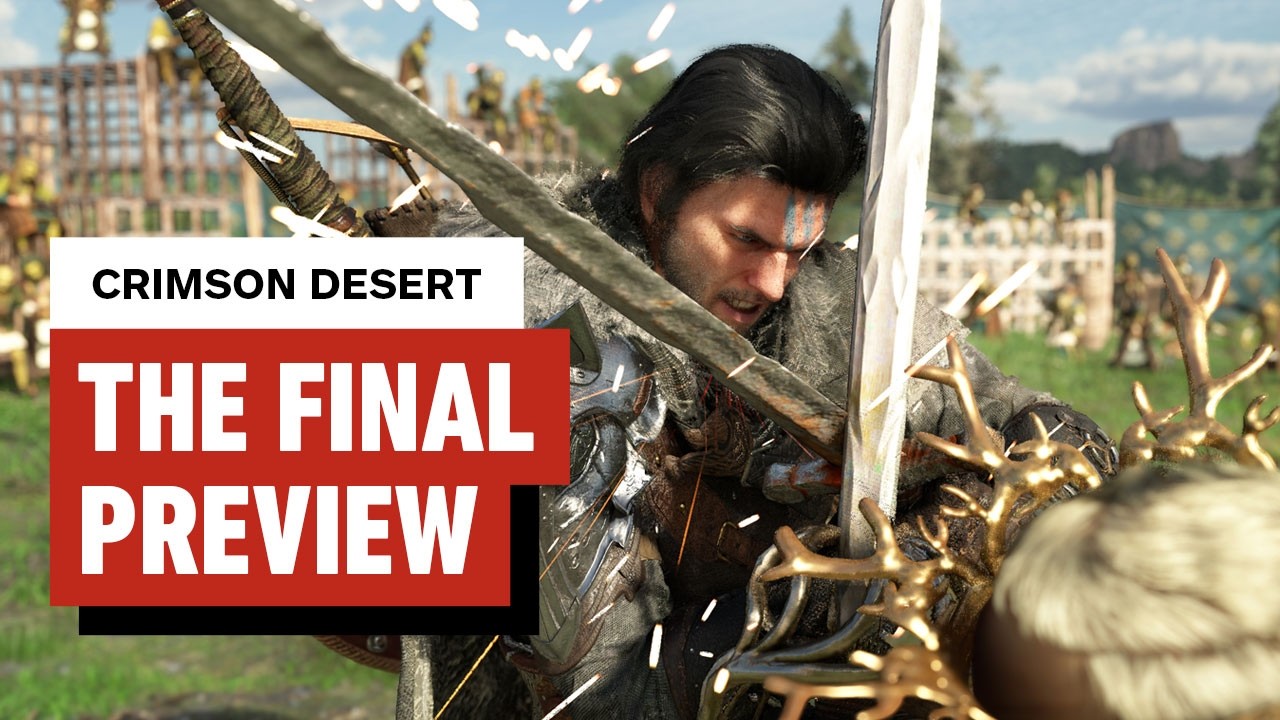
Field analysis repeatedly compares Crimson Desert’s melee to a bar brawl, not a ballroom dance. That’s not just flavor text; it’s a design philosophy. Combat is:
- Physics-aware: enemies ragdoll, collide with scenery, and react to grapples and throws.
- Space-dominant: verticality, ledges, and mounts all factor into positioning and crowd control.
- Cinematically framed: finishers, boss intros, and set-piece clashes lean into high-drama camera work.
Watch: Transmitting Gameplay footage from the field: Official Combat & World Preview
Mounted combat and grappling appear to be key differentiators. Horses aren’t just traversal tools; they’re integrated into the core combat loop, enabling drive-by strikes, chase sequences, and fast repositioning in chaotic skirmishes. Grappling, meanwhile, anchors the game’s tactile brutality—pulling enemies off ledges, slamming them into geometry, or using the environment as an improvised weapon.
For developers, this raises non-trivial implementation questions:
- How do you maintain animation readability when physics and grapples constantly disrupt ideal poses?
- What blend tree and IK strategies keep attacks legible while still allowing for chaotic collisions?
- How do you budget networked or systemic physics in a world this dense without sacrificing stability?
Crimson Desert’s answer appears to be: lean into the mess, then frame it cinematically. The visual throughput and animation systems are tracking toward top-tier action RPG benchmarks, but they’re being asked to survive in a sandbox that’s closer to a systemic experiment than a curated stage.
Sandbox vs. Scripted: Emergent Chaos as a Feature, Not a Bug
The final preview intel makes one thing clear: Crimson Desert is deliberately blurring the line between scripted RPG and sandbox simulator. Boss encounters are still cinematic and staged, but they’re embedded in a playspace where:
- Environmental objects can be weaponized or destroyed.
- Enemy pathing can be disrupted via physics or terrain.
- Mounts, vertical routes, and grapples can trivialize or recontextualize encounters if players are clever.
This is high-risk design. The more tools you give players to break your set pieces, the more your content pipeline and encounter design teams must pivot from authored choreography to systems stewardship. The upside is enormous: moments of emergent brilliance that no designer could have scripted. The downside: QA and balance complexity scale non-linearly.
For #indiegame and AA teams, Crimson Desert is a cautionary but inspiring blueprint. You don’t need its budget, but you can study its prioritization: invest in a few deeply systemic mechanics (physics, grappling, mounts, verticality) and let them meaningfully interact, rather than scattering effort across dozens of shallow features.
UX and UI: Combat-Ready, But Not There Yet
The intel flags a key weak point: UI that still needs combat-readiness polish. In a game this noisy—visually, physically, and systemically—the HUD and UX layer must do heavy lifting:
- Communicating threat direction and priority amidst particle-heavy chaos.
- Surfacing stamina, cooldowns, and positional advantages without overwhelming the screen.
- Clarifying contextual actions (grapples, finishers, mount interactions) in the heat of battle.
If the UI lags behind the systems, players feel overwhelmed rather than empowered. For developers tracking Crimson Desert as a reference, this is a reminder that UX is part of the combat system, not an afterthought.
Watch: Transmitting Gameplay footage from the field: Cinematic World & Systems Montage
Strategic Takeaways for Developers Watching Crimson Desert
Crimson Desert’s current trajectory positions it as a flagship deployment in the open-world combat sector. Key strategic learnings for studios:
- Design for systems, then decorate with cinematics – not the other way around.
- Embrace verticality and mounts as first-class mechanics, not optional traversal garnish.
- Treat physics as gameplay, not just spectacle; it should meaningfully shift tactics.
- Accept controlled chaos: emergent outcomes will break your scripts, but they’ll also generate the kind of player stories that drive organic discovery and long-tail engagement.
As this medieval sandbox edges toward launch, the question isn’t whether Crimson Desert will be big—it’s whether its systems-first philosophy can stay coherent under player pressure. From this week’s reports, it’s clear: the team is aiming for nothing less than a living, volatile battlefield where every cliff, rooftop, and saddle is a design lever.
In a market saturated with safe open worlds, Crimson Desert is deliberately choosing volatility. For anyone in #gamedev, that alone makes it one of the most important development update case studies to watch this year.
Sources and corrections
This archive entry does not have a verified article-source list. Images and video embeds alone are not evidence for every claim.
Found an error? Request a correction. Include the passage and a supporting source.
Your games, in one place
Keep up with Crimson Desert
Follow this game to collect its posts in your personal feed. Come back to see what you missed.