Automated archive / Counter-Strike 2
Sector Intelligence: Cologne 2026 Rewires Counter-Strike 2’s Economy, Viewing, and Map Meta
Cologne 2026 is reshaping Counter-Strike 2’s Major experience with targeted stickers, personalized souvenirs, and a fully rewired hub—while Valve quietly tightens map geometry and combat readability. This week’s Sector Intelligence Report breaks down how these systems-level changes impact players, traders, and...
AI-generated summary. This archive article does not have a current recorded source check. Check linked sources before relying on details. Editorial policy
Cologne 2026 Major Hub Comes Online
Valve has flipped the switch on the IEM Cologne 2026 Major ecosystem, and this week’s Counter-Strike 2 Sector Intelligence Report is all about systems: viewing, economy, cosmetics, and map-level #gamedev refinements.
The new Cologne 2026 Major Hub is now live, giving players a single operational screen for:
- Viewer Pass activation and coin tracking
- Pick’Em Challenge participation and prediction rewards
- Cologne 2026 Coin progression, with upgrade paths tied directly to your Pick’Em performance
This is more than a cosmetic wrapper. The hub reframes the Major as a season-long operations dashboard: you’re not just watching matches, you’re managing a live campaign of predictions, coin upgrades, and leaderboard climbs.
Tactical UI & Spectator Clarity
Valve’s patch notes highlight a quiet but crucial layer of combat readability:
- Overtime timelines now report accurately, reducing confusion in extended series and enabling clearer broadcast storytelling.
- Weapon pickup hints no longer ghost after entities are removed, trimming away misleading UI noise in tense eco rounds.
- In-eye flash for spectators has been amplified, sharpening the spectator’s understanding of who is blind, for how long, and why a duel breaks the way it does.
From a #gamedev and broadcast design perspective, these are high-value micro-fixes: they don’t change how Counter-Strike 2 plays, but they dramatically tighten how it’s read—by casters, analysts, and players breaking down VODs.
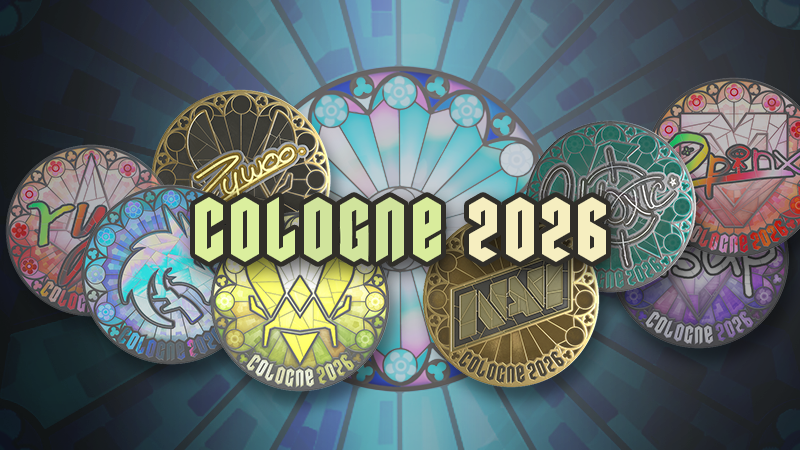
Economy Reforged: Souvenirs and Trade-Ups
The week’s most impactful systemic tweak is economic: Souvenir items can now be used in Trade Up Contracts alongside standard skins.
The catch—and it’s a big one—is clean and brutal: once you commit a Souvenir into a contract, all Souvenir attributes are stripped, and the output is a single normal item, one tier higher, from the defined exchange pool.
Design-wise, this is Valve:
- Collapsing sentimental value into raw economic value. That old Mirage B anchor souvenir can now become a stepping stone toward a higher-tier skin.
- Flattening legacy inventory clutter. Instead of deadweight nostalgia, Souvenirs now sit on a spectrum between emotional keepsake and upgrade fuel.
For traders, this introduces a new optimization puzzle: when does a low-value Souvenir’s upgrade potential outstrip its niche collector premium?
The Cologne 2026 Shop: No More Blind Crates
Parallel to the hub, the Cologne 2026 Major Shop has been rebuilt around transparency and player agency.
Key structural changes:
- No more blind capsules: you target exact team or player stickers. Want a holo FURIA logo or a foil donk autograph? You buy that sticker, not a probability.
- Market-driven token pricing: sticker prices shift dynamically with demand. Popular emblems surge; others recede, creating a living micro-market inside the official shop.
- Anti-regret refund shield: if a sticker’s price drops by more than 25 tokens within 24 hours of your purchase, Valve refunds the full token difference.
From a systems design angle, this is a notable pivot away from pure gacha mechanics and toward a hybrid of storefront and market logic. It aligns more closely with broader regulatory and player sentiment trends, without abandoning scarcity or demand-driven pricing.
Tokens as Precision Currency
Tokens now function as a universal currency layer:
- You buy tokens.
- You redeem them for any sticker in the pool, at its current dynamic price.
This decouples spend from randomness and lets players plan specific visual loadouts around teams, players, or speculative market plays.
Souvenir-O-Matic: Personalized Match Relics
The new Souvenir-O-Matic takes the old passive drop system and turns it into an opt-in narrative tool.
Instead of receiving random souvenirs from a pre-defined pool, players assemble their own trophy:
- Choose the match and moment that matters.
- Lock in team signatures, map context, and your preferred visual.
For an #indiegame designer looking at Counter-Strike 2 as a live-service case study, this is a strong example of:
- Turning static rewards into authored memories.
- Giving players editorial control over what becomes a keepsake.
It’s a subtle but powerful shift: souvenirs become curated story capsules, not just statistical loot.
Map Meta: Cache & Ancient Tighten the Angles
Beyond the Major ecosystem, Valve pushed a collision and audio calibration pass on key competitive maps.
Cache: Collision and Footstep Fidelity
On Cache, two intertwined layers were tuned:
- Player and grenade collision tightened to eliminate abusable micro-angles and unintended boost or nade exploits.
- Material blending re-tuned for more precise footstep audio, making sound-based reads more reliable and consistent.
For high-level play, this changes how teams:
- Trust info from audio cues when calling rotations or gambles.
- Execute nade lineups that previously relied on borderline geometry quirks.
Ancient: Sightline Denial
On Ancient, a critical wall gap has been closed, removing a cheap sightline that offered outsized informational value at minimal risk.
This is a classic competitive map maintenance move:
- Reduce low-risk, high-reward off-angles.
- Force teams back into contested, readable lines of engagement.
From a #gamedev perspective, both changes underscore Valve’s current Counter-Strike 2 philosophy: iterative, surgical adjustments that preserve map identity while sanding down abusive edge cases.
Sector Takeaways
Over the last seven days, Counter-Strike 2’s Cologne 2026 operation has:
- Recast the Major as a systemic, player-directed campaign via the hub and Viewer Pass.
- Evolved cosmetics from random drops into targeted, market-aware purchases with built-in anti-regret mechanisms.
- Upgraded souvenirs into personalized, story-driven artifacts.
- Continued the long war on unintended map exploits and unclear audio/visual feedback.
For players, this means more control over how you watch, spend, and flex. For designers and #indiegame teams studying Counter-Strike 2, it’s a live demonstration of how to modernize a legacy esport without detonating its core identity.
Sources and corrections
This archive entry does not have a verified article-source list. Images and video embeds alone are not evidence for every claim.
Found an error? Request a correction. Include the passage and a supporting source.
Your games, in one place
Keep up with Counter-Strike 2
Follow this game to collect its posts in your personal feed. Come back to see what you missed.
More to read about Counter-Strike 2
- Source-checked briefCounter-Strike 2 update adjusts AUG reload and audio
A Counter-Strike 2 update adds a dropped defuse-kit ping indicator, shortens AUG reload time, and fixes several audio and map issues. Dropped defuse kits have a ping icon. The AUG reload is half a...
- Source-checked briefCounter-Strike 2 update fixes grenade crosshair display
A Counter-Strike 2 update fixes grenade crosshair rendering for a specific thickness setting and makes equipped gloves visible in more interface scenes. It also includes map lighting and...
- Source-checked briefCounter-Strike 2 adds crosshair options and smoke aid
A Counter-Strike 2 update adds new crosshair customization and changes how crosshair settings are shared. It also enables grenade crosshairs during freeze time for insta-smokes when holding a...