Automated archive / Counter-Strike 2
Sector Intelligence: Cologne 2026 Rewrites the Counter-Strike 2 Economy and Esports UX
Counter-Strike 2’s Cologne 2026 cycle is quietly rewriting how Majors, cosmetics, and competitive UX intersect. From a rebuilt, dynamic Major Shop to new scripting hooks and map refinements, Valve is turning CS2 into a sharper, more data-driven live-service platform.
AI-generated summary. This archive article does not have a current recorded source check. Check linked sources before relying on details. Editorial policy
Sector Intelligence Report: Counter-Strike 2 – Week of May 25, 2026
Counter-Strike 2’s live ops team just pushed one of the most consequential pre-Major refits we’ve seen in years. Across the Cologne 2026 hub, the rebuilt Major Shop, and a series of surgical map and systems tweaks, Valve is quietly stress‑testing what a modern, data‑driven CS economy and spectator stack looks like in 2026.
This week’s report breaks down how these moves reshape the player economy, esports UX, and the underlying tools available to #gamedev teams and map scripters.
Cologne 2026 Major Hub: From Broadcast Companion to Live Service Spine
The IEM Cologne 2026 Major Hub is now online, and it’s more than a glorified menu. It’s positioned as a persistent operations layer:
- Upgradeable Cologne 2026 Coin – The coin is once again a performance‑sensitive cosmetic, but the messaging leans harder into competition: win Pick’Em predictions, climb an Active Pass Leaderboard, and measure yourself against your squad. That’s a subtle shift from passive viewing to competitive viewing.
- Viewer Pass + Pick’Em Integration – The hub consolidates viewing, prediction, and reward tracking into a single tactical UI. For a live-service shooter, this is the closest thing to a seasonal operations command center CS2 has had.
- Spectator Visual Fidelity – Overtime timelines now report correctly, pickup hints no longer “ghost,” and in-eye flash for spectators has been amplified. This is a pure esports UX play: viewers and analysts get more accurate combat telemetry with fewer false signals.
For #indiegame studios studying Counter-Strike 2, the hub is a blueprint: treat tournament integrations like limited-time live service seasons with their own progression, economy hooks, and data‑rich UI.
Major Shop 2.0: Tokenized, Dynamic Pricing and Anti‑Remorse Design
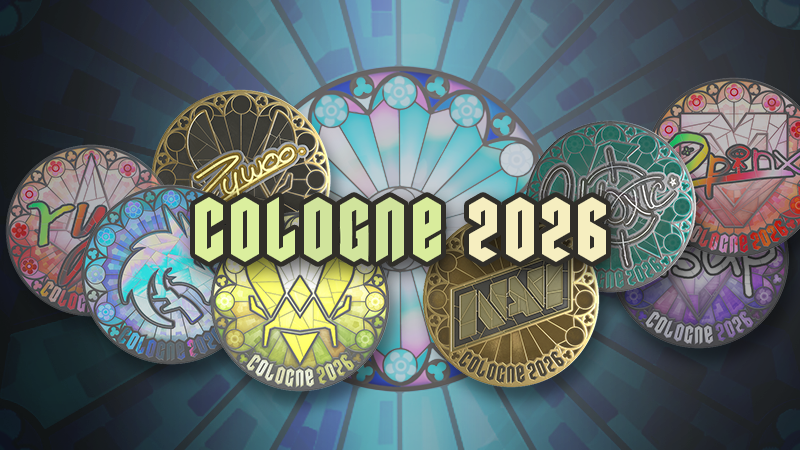
The rebuilt Cologne 2026 Major Shop is the most aggressive redesign of CS’s cosmetic monetization since the introduction of cases.
Direct-Target Sticker Acquisition
Blind crates are out. Players now target and acquire specific team and player stickers at a token cost:
- No RNG on which sticker you get; the randomness shifts from content to pricing and timing.
- This aligns with broader industry pressure against loot-box mechanics while preserving a speculative layer for collectors.
Dynamic, Market-Driven Pricing
Sticker prices now shift with demand:
- High‑demand emblems (e.g., a surging underdog or breakout star) climb in token price.
- Less popular stickers become cheaper, naturally nudging collectors toward a broader spread.
The 25-token price protection is the key design twist: if a sticker’s cost drops by more than 25 tokens within 24 hours of your purchase, you get an automatic refund of the difference. That’s a direct counter to buyer’s remorse and a strong signal that Valve wants players to engage early instead of waiting out the meta.
For economy designers in #gamedev, this is a live A/B test of:
- Dynamic pricing that reacts to esports narratives.
- Consumer‑friendly safeguards that keep speculation from feeling predatory.
Souvenir-O-Matic & Trade Ups: Personalization Over Passive Drops
Two parallel systems redefine how souvenirs work around the Major:
Souvenir-O-Matic: Curated Memory Crafting
Instead of static, match‑agnostic Souvenir drops, players now craft personalized Souvenirs:
- Choose the match, map, and moment that matter to you.
- Build a trophy that’s more narrative artifact than random drop.
This leans into player-authored history—a trend we’re seeing across live-service shooters.
Souvenirs in Trade Up Contracts
Souvenir items can now be fed into Trade Up Contracts alongside standard items, with a hard catch:
- All Souvenir attributes are stripped on input.
- Output is a single, normal item one tier higher, drawn from the exchange pool.
Design-wise, Valve is explicitly telling players: nostalgia has an opportunity cost. You can keep the history, or you can liquidate it for progression. That’s a clean, legible tension in the economy loop.
Mobility & Weapon Handling: Ladder Logic and AWP Flow
Movement and weapon feel got another round of micro‑tuning:
- weapon_accuracy_stack_boost_limit now governs boosted ladder inaccuracy at high stacks. This is a direct strike at ladder abuse and edge‑case accuracy exploits.
- AWP draw-to-idle transitions are smoother, tightening the perceived responsiveness of the game’s most polarizing weapon.
- Grenade jump-throws and preview cams have been re‑synchronized, boosting execution reliability for lineups—critical for high‑level play and coaching.
These are small, but they speak to a consistent CS2 theme: incrementally eroding the gap between what players intend to do and what the engine actually executes.
Cache & Ancient: Collision, Audio, and Line-of-Sight Refinement
Map work this week centers around Cache and Ancient, with a clear emphasis on competitive integrity:
Cache: Precision Pathing and Audio Intel
- Player and grenade collision has been tightened to reduce exploitable angles.
- Window cover models now better represent collision and decal impact.
- Material blending has been re-tuned for more precise footstep audio, making sound-based intel more reliable.
For both pros and map designers, this is a reminder that collision and material tagging are not mere polish—they’re balance levers.
Ancient: Sightline Denial
- A critical wall gap has been closed, removing a cheap sightline.
This is the classic CS philosophy: eliminate low‑skill, high‑reward angles that undermine the tactical layer.
Spectator Optics: Cleaner Feeds for a Broadcast-First Era
Spectator improvements this week are explicitly broadcast‑driven:
- No more ghosted silhouettes when cycling targets.
- No more glitchy overlays across different post-process zones.
- In-eye spectator flash has been amplified for better clarity of utility impact.
For tournament operators and content creators, this means fewer visual desyncs and a cleaner storytelling canvas. For a game that now lives as much on Twitch and YouTube as on player monitors, that’s not a side concern—it’s core product.
Scripter Arsenal: Deeper Hooks into Rounds and Economy
Behind the scenes, Counter-Strike 2 quietly expanded its scripting surface area:
- New instance hooks:
RegisterCheatCommand,GetAllPlayerControllers,OnBeginRoundRestart,SetRoundRemainingTime. - Economy control:
AddMoneySpendableNow,GetMoneySpendableNow,AddMoneyEarnedForNextRound,GetMoneyEarnedForNextRound. - Helmet state control at the pawn level.
For #gamedev teams, this is huge: it opens the door to richer custom modes, training tools, and simulation scenarios. Community map makers can prototype alternative economies, round flows, and armor logic without engine‑level access.
Strategic Takeaways
- Economy as Live Narrative – The dynamic Major Shop and Souvenir-O-Matic show Valve treating the esports economy as a story engine, not just a cash register.
- Esports UX as First-Class Feature – Spectator clarity, overtime timeline fixes, and cleaner collision aren’t just bugfixes; they’re competitive broadcast features.
- Tooling the Community – New scripting hooks and economy controls move Counter-Strike 2 closer to a platform for tactical experimentation.
Counter-Strike 2’s latest development update is less about headline features and more about systemic pressure: tightening the screws on fairness, expressiveness, and economic clarity ahead of one of the year’s biggest stages.
Sources and corrections
This archive entry does not have a verified article-source list. Images and video embeds alone are not evidence for every claim.
Found an error? Request a correction. Include the passage and a supporting source.
Your games, in one place
Keep up with Counter-Strike 2
Follow this game to collect its posts in your personal feed. Come back to see what you missed.
More to read about Counter-Strike 2
- Source-checked briefCounter-Strike 2 update fixes grenade crosshair display
A Counter-Strike 2 update fixes grenade crosshair rendering for a specific thickness setting and makes equipped gloves visible in more interface scenes. It also includes map lighting and...
- Source-checked briefCounter-Strike 2 adds crosshair options and smoke aid
A Counter-Strike 2 update adds new crosshair customization and changes how crosshair settings are shared. It also enables grenade crosshairs during freeze time for insta-smokes when holding a...
- Source-checked briefCounter-Strike 2 update adjusts kick rules and reload issues
A September 24 Counter-Strike 2 update revises the loading-screen rules description and changes how team-damage kick decisions are made. It also fixes silent-reload cases that could speed reloads...