Automated archive / Control Resonant
Inside Control Resonant’s No-Gun Combat Doctrine and Paranatural City Warfare
Control Resonant is doubling down on melee-first combat, hostile architecture, and paranatural cityscapes, pushing player cognition and spatial awareness to the edge. This week’s intel breaks down how its no-gun doctrine, reactive environments, and Manhattan takeover are reshaping action design.
AI-generated summary. This archive article does not have a current recorded source check. Check linked sources before relying on details. Editorial policy
Sector Intelligence Report // Control Resonant – Week of June 13
Control Resonant is quietly rewriting the combat playbook. Over the last seven days, the feeds have shifted from cryptic paranatural teases to concrete doctrine: no firearms, high-velocity melee, and environments that behave less like levels and more like hostile entities. For #gamedev and #indiegame teams watching from the perimeter, this week’s signals outline how Remedy (and partners) are escalating systemic design, player workload, and spatial storytelling.
1. Tactile Kinetic Combat: No Guns, No Safety Net
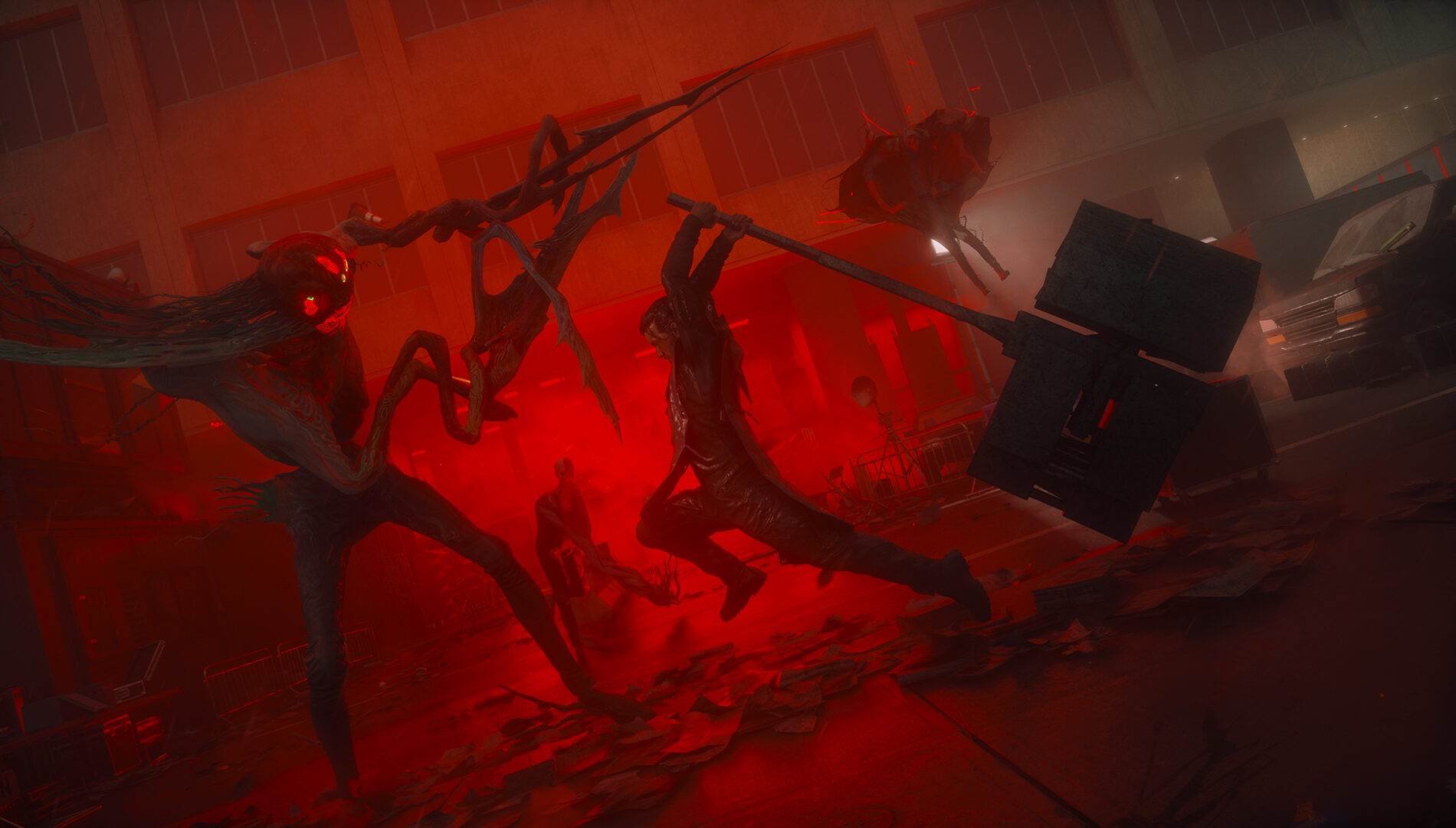
The latest hands-on preview frames Control Resonant as a melee-action powerhouse that deliberately removes guns as a comfort mechanic. Instead of ballistics, the combat loop leans on:
- High-velocity melee chains – Short, brutal combos that demand commitment rather than kiting.
- Precision parries – Timing-critical blocks that appear to be the main defensive currency.
- Supernatural crowd control – Telekinetic throws, knock-ups, and staggers that keep dense enemy packs manageable.
This is a notable pivot from the original Control’s hybrid gun/ability rhythm. Here, the design intent seems to be continuous forward momentum: the player is rewarded for closing distance, staying in the pocket, and making micro-decisions under pressure.
From a #gamedev perspective, this implies:
- Tighter animation timing windows to sell impact and fairness in a no-gun sandbox.
- Aggro and formation AI tuned for close-range swarming rather than mid-range trading.
- High cognitive load as players constantly recalculate positioning, threat priority, and parry windows without the fallback of ranged suppression.
The preview’s talk of “arena-style encounters” suggests handcrafted combat bowls where readability and silhouette design are critical. In a world with no firearms, clarity of telegraph becomes the new aim assist.
2. Take Control: The Oldest House as Active Combatant
The “Take Control” trailer for CONTROL Resonant reinforces a familiar but sharpened thesis: the Oldest House is not a backdrop; it’s a co-combatant. The intel highlights:
- Reality breaches as encounter pacing tools – Fissures, shifts, and sudden spatial distortions that can reset positioning mid-fight.
- Weaponized telekinesis as standard loadout – Not an optional power fantasy, but a baseline expectation in the player kit.
- Continuous situational awareness – Floors, walls, and airspace are all potential threat vectors.
For designers, this reads like a commitment to environmental volatility as a first-class system:
- Level art and layout must support dynamic reconfiguration while maintaining navigational clarity.
- Encounter scripting likely blends systemic triggers (health thresholds, crowd density) with authored set-pieces.
- UX and VFX need to signal when the architecture is about to "fight back," preventing cheap deaths in a high-intensity melee ecosystem.
This is a useful case study for #indiegame teams exploring reactive spaces on smaller budgets: even modest geometry shifts, if well signposted and tied to combat states, can make arenas feel alive without requiring full procedural destruction.
3. Paranatural Manhattan: Urban-Scale Resonance
Watch: Transmitting Gameplay footage from the field: Paranatural Manhattan Operations Trailer
The Paranatural Manhattan trailer widens the operational theater beyond the Oldest House, dropping Control Resonant into a city grid that’s actively folding in on itself. Key signals from the feed:
- Streets that bend and overlay realities – Think layered city instances phasing over one another.
- Hostile anomalies and psychic suppression fire – Paranatural threats integrated into urban cover and sightlines.
- Bureau squads moving through unstable resonance – AI allies navigating the same shifting geometry as the player.
From a technical and design standpoint, this suggests:
- Streaming-friendly level partitioning: Manhattan blocks as modular cells that can phase, rotate, or overlap without blowing memory budgets.
- Dual-purpose set dressing: Street furniture, vehicles, and signage that serve both as telekinetic ammo and as dynamic cover.
- AI pathfinding under flux: Navmeshes that can tolerate partial invalidation as streets twist, forcing agents to re-route on the fly.
Thematically, moving Control Resonant into Manhattan also repositions the franchise from "secret interior nightmare" to public-facing paranatural crisis. That shift opens narrative space for:
- Civilian risk and evacuation beats.
- Open-sky vistas that contrast with the Oldest House’s brutalist claustrophobia.
- A broader sense of scale for resonance events, hinting at systemic breakdown beyond Bureau containment.
4. Design Takeaways for Developers Tracking Control Resonant
For teams monitoring Control Resonant as a live reference, this week’s transmissions converge on a few actionable patterns:
4.1 Melee-First in a Shooter-Literate Market
- Risk–reward tuning is king: Without guns, players need reliable defensive verbs (parries, dodges, stuns) that feel expressive, not punitive.
- Hit-stop, camera shake, and audio must sell the power fantasy; melee without feedback is just animation.
4.2 Environments as Systems, Not Sets
- Treat spaces as stateful entities: stable, unstable, breached, and reconfigured states that meaningfully affect combat options.
- Use predictable transformation rules (e.g., specific resonance patterns, audio cues) so volatility feels learnable, not random.
4.3 Scaling Paranatural Design to Urban Grids
- Architect cities with clean modularity to support reality overlays without full scene rebuilds.
- Treat AI and navigation as co-design problems with level layout, not post-hoc fixes.
Control Resonant’s current trajectory positions it as a high-cognitive-load, melee-driven action title that weaponizes space as aggressively as it does enemies. As more development update beats land, it’s worth watching how the team balances readability, difficulty, and spectacle across both the Oldest House and a resonant Manhattan.
Sources and corrections
This archive entry does not have a verified article-source list. Images and video embeds alone are not evidence for every claim.
Found an error? Request a correction. Include the passage and a supporting source.
Your games, in one place
Keep up with Control Resonant
Follow this game to collect its posts in your personal feed. Come back to see what you missed.
More to read about Control Resonant
- Source-checked briefControl Resonant is available on PS5 with DualSense features
Control Resonant is available on PS5. The game uses the DualSense speaker for radio calls and adaptive-trigger feedback for specific abilities, according to the announcement. PS5 players can...
- Source-checked briefControl Resonant launches on PS5 September 24
Control Resonant is scheduled to launch on PlayStation 5 on September 24. Players control Dylan across focused Manhattan areas, with main missions, side stories, and optional timed arcade...
- Source-checked briefControl Resonant is scheduled for Xbox on September 24
Xbox Wire lists Control Resonant for September 24, optimized for Xbox Series X|S and supporting Xbox Play Anywhere. The announcement describes Dylan Faden emerging into a warped Manhattan during a...