Automated archive / Assassin's Creed Black Flag Resynced
Optimizing Your Assassin’s Creed Black Flag Resynced Run Before Launch Day
Assassin’s Creed Black Flag Resynced is evolving into a systems-forward remaster, tightening everything from global launch timing to gold routes and officer buildcraft. This week’s intel breaks down how Ubisoft is modernizing a classic sandbox for contemporary players and developers alike.
AI-generated summary. This archive article does not have a current recorded source check. Check linked sources before relying on details. Editorial policy

Sector Intelligence: The State of Assassin’s Creed Black Flag Resynced This Week
Assassin's Creed Black Flag Resynced is quietly shifting from “nostalgic remaster” to “live simulation lab,” and this week’s data packets sketch a clear priority stack for players and #gamedev watchers alike. From synchronized global launch timing to granular gold routing and officer optimization, Ubisoft’s latest build is broadcasting one message: this is a systems-first reimagining of a classic sandbox.
Below, we break down the last seven days of signals into actionable intel for both players and developers tuning into the Caribbean grid.
Launch Window: Global Desync Exploit Neutralized
Ubisoft has recalibrated the global deployment window for Assassin’s Creed Black Flag Resynced, explicitly targeting the long-standing “New Zealand trick” that traditionally gave some players an unofficial head start.
For players, the takeaway is simple: no more time-zone arbitrage. For developers and #indiegame teams studying release ops, this is a clear case study in:
- Simultaneous content parity: Reducing fragmented first impressions and spoiler leakage.
- Load balancing: Aligning peak concurrency for matchmaking, telemetry, and live-ops analytics.
- Messaging clarity: One synchronized story beat, instead of regionally staggered noise.
In practice, this means everyone hits the water at roughly the same moment—no more stealth early adopters quietly reverse-engineering systems before the wider audience arrives.
Onboarding Protocols: How to Treat the First Hours as a Systems Tutorial
The “Operational Onboarding Protocols” packet reframes Black Flag Resynced’s opening as a controlled sandbox rather than a cinematic warm-up. The directive: prioritize systems calibration over sightseeing.
Key early-game priorities:
1. Naval Capability Ramp-Up
The Jackdaw isn’t just a story prop—it’s the main progression spine. Fast-tracking hull, broadside, and maneuverability upgrades early stabilizes the difficulty curve and reduces late-game grind. From a design lens, this reinforces:
- Ship-as-character design: The Jackdaw evolves in parallel with Edward Kenway.
- Feedback clarity: Stronger ship → visibly different encounter outcomes.
2. Economic Scaffolding
Instead of drifting between icons, the report recommends building a repeatable income loop in the first hours. That means:
- Identifying low-risk contracts near early hubs.
- Chaining naval encounters along efficient routes.
- Converting loot into targeted upgrades rather than hoarding.
This structured opening is a subtle but important development update: the remaster is nudging players toward intentional play, leveraging the original systems but reframing the onboarding around modern open-world fatigue concerns.
Optimized Credit Streams: Gold Protocols for the Resynced Economy
The “Gold Protocols” data packet dives deeper into the Caribbean economy, outlining how to treat every profitable route like a repeatable operation.
Core pillars of optimal credit flow:
- Synchronized Naval Raids: Hit convoys and vulnerable trade routes in short, predictable cycles.
- Contract Stacking: Accept overlapping objectives along the same vector to multiply payouts per minute played.
- Efficient Loot Conversion: Sell or repurpose cargo with a clear upgrade target—hull, cannons, or officer-linked perks—rather than spreading resources thin.
From a #gamedev perspective, this underlines how Black Flag Resynced still leans on:
- Short-session loops embedded inside a large map.
- Low-risk, high-feedback runs to maintain engagement without forcing marathon sessions.
The result is a remaster that respects the original’s economy while surfacing its optimal routes more clearly to modern players used to min-maxable live-service grinds.
Officer Uplink: The Jackdaw as a Modular Build
The new Officer systems in Assassin’s Creed Black Flag Resynced turn your crew into a modular upgrade grid for the Jackdaw. Each Officer now arrives with:
- Clear unlock conditions.
- Defined tactical roles (combat, economy, exploration support, etc.).
- Quest chains that pay out in both resources and mechanical perks.
For players, the optimal approach is to:
- Prioritize officers that align with your preferred loop (gold farming, combat dominance, stealth/covert boarding).
- Treat officer quests as investment tracks, not side distractions.
For developers, this looks like a retrofitted layer of RPG-style buildcraft grafted onto a legacy open world—without rewriting the core fantasy. It’s a smart way to modernize a classic: add systemic depth through crew customization rather than rewriting the story spine.
Visual Pipelines: Performance vs Balanced vs Fidelity
Black Flag Resynced now offers three distinct rendering modes—Performance, Balanced, and Fidelity—each tuned to a different combat tempo and visual threshold.
Performance Mode
- Target: High frame-rate responsiveness.
- Best for: Precision boarding, tight parries, and fast naval maneuvering.
- Design implication: Reinforces the game’s identity as an action-first sandbox, especially for players coming from modern 60+ FPS standards.
Balanced Mode
- Target: Middle ground between resolution and FPS.
- Best for: Players who want stable engagements without sacrificing too much visual clarity.
- Design implication: This is the “default” simulation profile—likely where Ubisoft expects most players to live.
Fidelity Mode
- Target: Higher resolution and effects at the cost of speed.
- Best for: Screenshot hunters, world-tour explorers, and players who treat the Caribbean as a visual diorama.
- Design implication: Reinforces the remaster’s value proposition as a visual refresh, particularly on high-end displays.
For #indiegame and #gamedev teams, this is a clean case study in user-facing performance trade-offs: explicitly letting players tune their experience rather than hiding it behind a single, compromised default.
Emergent Naval AI: When the Simulation Fights Itself
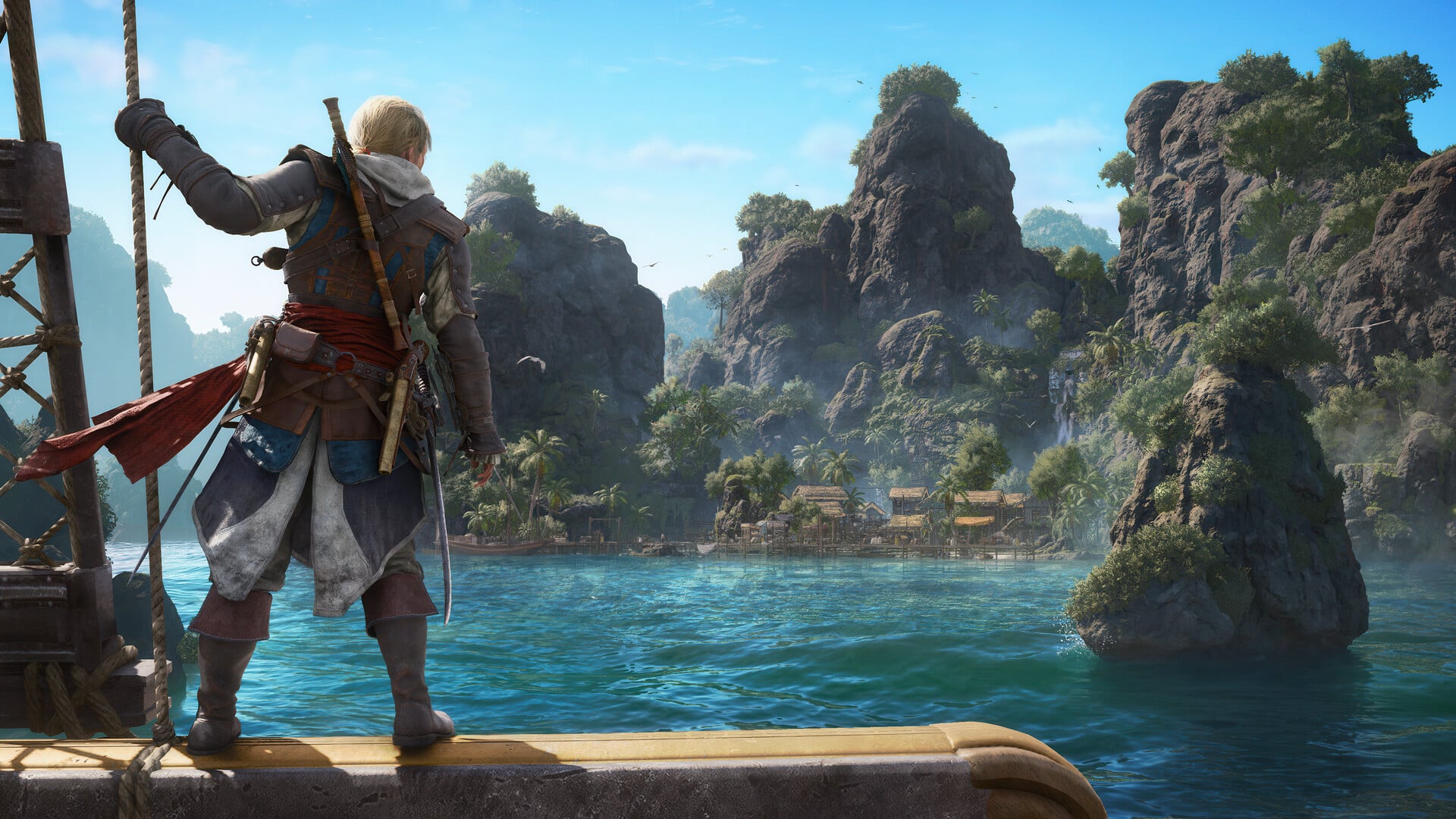
One of the most telling field logs this week describes a multi-ship naval engagement spiraling into unscripted chaos: AI vessels cross-firing, pathfinding adjusting on the fly, and overlapping boarding states.
This is where the “Resynced” label earns its keep:
- Emergent conflict: Systems colliding without direct designer scripting.
- AI robustness: Pathfinding and targeting logic holding together under chaotic conditions.
- Replay value: No two sea battles resolving in quite the same way.
For game developers, this is a reminder that memorable moments often come from systemic friction, not bespoke set-pieces. The remaster appears to lean into that, stress-testing scenarios where AI logic is forced to improvise rather than follow a linear script.
First 18 Minutes: Confirming the Remaster’s Intent
The initial 18-minute gameplay capture confirms that Assassin’s Creed Black Flag Resynced isn’t a simple resolution bump. Across naval combat, stealth insertions, and parkour, the build suggests:
- Refined control clarity: Inputs tuned for modern controllers and expectations.
- Updated visual pipelines: Lighting, materials, and VFX reworked to sit comfortably on current-gen hardware.
- Preserved encounter pacing: The cadence of early missions feels familiar, but sharper.
Watch: Transmitting Gameplay footage from the field: Official Black Flag Resynced systems showcase
In other words, this is a systems-preserving, feedback-enhancing remaster: Ubisoft is not rewriting the DNA, but it is amplifying the signals that made Black Flag’s open-world loop so enduring.
This Week’s Strategic Takeaway
Assassin’s Creed Black Flag Resynced is positioning itself as a modern systems sandbox wearing a legacy narrative coat. Global launch synchronization, early-game economic scaffolding, officer-based buildcraft, and explicit graphics modes all point to the same thesis: give players clearer levers, faster.
For players, that means planning your run like an operation—optimize gold routes, lock in the right officers, and pick a visual mode that matches your combat tempo. For #gamedev and #indiegame teams, Black Flag Resynced is rapidly becoming a live case study in how to reassert systemic depth inside a familiar IP without losing the soul of the original.
Sources and corrections
This archive entry does not have a verified article-source list. Images and video embeds alone are not evidence for every claim.
Found an error? Request a correction. Include the passage and a supporting source.
Your games, in one place
Keep up with Assassin's Creed Black Flag Resynced
Follow this game to collect its posts in your personal feed. Come back to see what you missed.