Automated archive / Apex Legends
Apex Legends Sector Intelligence: Storm Point Lockdown, Hemlok Containment, and 73K Bans in a Brutal Midseason Reset
Apex Legends just survived a brutal live-ops gauntlet: map lockouts, matchmaking failures, a Hemlok nerf, and 73,000+ cheaters wiped in a single split. This week’s sector intel unpacks how Respawn is prioritizing stability, competitive integrity, and data-driven balance in Season 28.
AI-generated summary. This archive article does not have a current recorded source check. Check linked sources before relying on details. Editorial policy
Sector Intelligence Report: Apex Legends – Week of April 2–9, 2026
Apex Legends just wrapped one of its most volatile weeks of Season 28: split-wide anti-cheat strikes, a hard map lockdown, a Hemlok nerf aimed squarely at ranked, and a live dev AMA lining up to dissect the midseason meta. From a #gamedev and live-ops perspective, this is the kind of week that exposes how a mature service game balances stability, fairness, and experimentation under fire.
Network Instability: Matchmaking Outage and Playlist De-Sync
Respawn’s backend took multiple hits this week, and the studio chose to surface the root causes with unusual clarity.
Global Matchmaking Failure and Recovery
On April 2, a critical global matchmaking outage took Apex Legends completely offline for multiplayer. The official network uplink confirms a full interruption of lobby-to-server handshakes, with engineers cycling backend routing layers until service was restored at 08:31 AM PT.
From a live-service #gamedev lens, this reads like a classic orchestration failure: routing misconfigurations or service dependency issues that propagate rapidly at scale. The key takeaway for players is that monitoring remains aggressive—Respawn framed it as a three-phase incident (detection, triage, resolution) rather than a vague “we’re looking into it.”
Dual-Impact Failure: Map Routing and Telemetry Crash
A follow-up Network Fault Report detailed two separate but compounding problems:
- Map rotation bug: Rotating Storm Point out and dropping E-District into the playlist created a “ghost lobby” state, where matchmaking chased retired nodes and stranded players in queues. New safeguards now gate map swaps to prevent stale search targets.
- Telemetry handling regression: A previous performance-monitoring fix mishandled invalid telemetry, choking the backend and cascading into outages. Respawn rolled back the change and is scheduling a hardened validation pass for a later deployment.
To soften the blow, every player gets 1 Epic Apex Pack, claimable by logging in within two weeks. It’s modest, but it signals accountability and keeps the compensation tied directly to the outage window.
Storm Point Lockdown and E-District Deployment
Storm Point wasn’t just rotated out for variety—it was hard-extracted due to a device-specific crash anomaly. That’s a big move: pulling a full BR map mid-season is disruptive, but it’s also the clearest signal that stability is being prioritized over routine cadence.
- Interim solution: E-District (daytime) steps in as the primary combat zone while engineering hunts a permanent fix for the crash.
- April Fools LTM extended: The April Fools mode was reactivated and kept live until April 6 at 12 PM PT, alongside charged-up Wildcard modes. This is clever live-ops: when stability is shaky, leaning into chaotic LTMs gives players a lower-stakes environment to ride out the turbulence.
Matchmaking stability has reportedly been restored, but expect continued monitoring as Storm Point debugging continues behind the scenes.
Hemlok Meta Containment and Subtle Sidearm Buffs

The Telemetry Patch Pulse dropped a targeted balance pass that hits one of the most oppressive weapons in the current ranked ecosystem: the Hemlok.
Hemlok Nerf: Compressing Burst Dominance
- Damage reduced to 22 per bullet
- Magazine size reduced by 2 across all tiers
In practice, this cuts both effective burst lethality and sustained pressure, especially at mid-range where coordinated squads were melting armor before enemies could react. Respawn’s data flagged the Hemlok as overperforming in both win rate and pick rate, a classic sign that a weapon is warping loadouts and engagement patterns.
For ranked players, this means:
- Less forgiving burst windows at mid-long range
- More reload downtime in extended fights
- A likely redistribution of pick rates back toward other mid-range anchors (R-301, Flatline, Nemesis depending on current tuning)
Trophy systems were also updated to reliably intercept Breach Charges, closing an exploit path that let players brute-force defensive setups in ways designers clearly didn’t intend.
P2020 Buff: Keeping Secondaries Relevant
The P2020 gets a +1 damage bump—seemingly tiny, but in the context of close-range TTK and armor break thresholds, it’s a nudge to keep sidearms tactically viable. The design intent is clear: reduce the Hemlok funnel and encourage more diverse loadouts, not just nerf the top performer into oblivion.
Horizon’s skin, previously quarantined for crash loops, has been re-enabled—another sign that visual content is being treated with the same stability scrutiny as core systems.
73,591 Bans: Anti-Cheat Goes Surgical in Split 2
Respawn’s anti-cheat report for Season 28, Split 2 is blunt:
- Total bans: 73,591 across all platforms
- PC: 70,242
- Console: 3,349
This wave wasn’t just about obvious aimbots. The team called out targeted action against:
- XIM/Titan-style adapters
- HWID spoofers
- DMA rigs
- Other exploit hardware and cheat signatures
Crucially, hardware stats are described as sub-classes within a wider threat matrix, which suggests a layered detection model: behavioral data, hardware fingerprints, and external tool signatures all feeding into a unified enforcement pipeline.
For competitive integrity, this is one of the most important signals Respawn can send. Ranked and ALGS-adjacent players have been vocal about input spoofing and DMA-based cheats; openly naming and targeting these vectors is a strong deterrent and a win for long-term trust.
Live-ops Transparency: Midseason AMA on Weapons and Legends
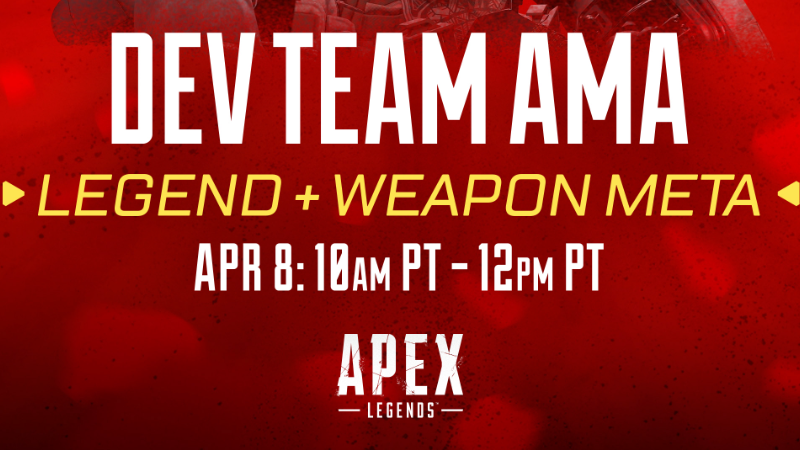
On April 8, 2026 at 10:00 AM PT, Respawn is hosting a focused AMA on the Season 28.1 midseason meta, with:
- Casey – Weapons Designer
- John – Legends Designer
The ground rules are tight: 1–2 focused questions per post, balance-only topics. That framing matters. It positions the AMA not as a marketing beat but as a live tuning intake, where community feedback is explicitly wired into the “live tuning matrix.”
From a #gamedev and #indiegame perspective, this is the kind of structured transparency many smaller teams aspire to: designers speaking directly to data, intent, and future knobs they’re willing to turn.
Expect discussion around:
- Hemlok fallout and replacement meta anchors
- Legends overperforming in the E-District + no-Storm-Point environment
- Edge-case interactions like Breach Charge vs. defensive utility
Monetization and Ecosystem: EA Play Charm Pipeline
EA Play subscribers now receive a rotating Apex Legends weapon charm as a recurring bonus, plus:
- 10% discount on EA digital purchases
- Up to 10-hour trials on new titles with progression carry-over on purchase
For players, it’s a low-friction cosmetic drip. For EA, it’s a cross-title retention mechanism that keeps Apex Legends in the center of its subscription value proposition.
From a business-side #gamedev angle, this kind of evergreen cosmetic pipeline is standard, but its success hinges on how desirable and visible those charms are in-game. If they read as low-effort filler, the perceived value tanks; if they’re thematically sharp and occasionally rare-feeling, they quietly boost both subs and engagement.
Strategic Outlook: Stability First, Precision Tuning Second
This week’s Apex Legends operations paint a clear priority stack:
- Stability over routine – Storm Point’s removal and the rollback of broken telemetry handling show a willingness to disrupt the schedule to protect uptime and crash rates.
- Competitive integrity as a pillar – 73K+ bans, with explicit targeting of high-end hardware exploits, is a strong statement to ranked grinders.
- Data-driven balance, publicly debated – Hemlok nerfs and P2020 buffs are backed by hard performance metrics, with a live AMA set up to iterate in public.
For players, the message is simple: expect a slightly less Hemlok-dominated ladder, a more reliable (if temporarily Storm Point-free) playlist, and a cleaner competitive field. For developers watching from the outside—AAA and #indiegame alike—this is a live case study in how a mature live-service shooter navigates the constant tension between innovation, fairness, and not breaking the servers that keep it all running.
Sources and corrections
This archive entry does not have a verified article-source list. Images and video embeds alone are not evidence for every claim.
Found an error? Request a correction. Include the passage and a supporting source.
Your games, in one place
Keep up with Apex Legends
Follow this game to collect its posts in your personal feed. Come back to see what you missed.
More to read about Apex Legends
- Source-checked briefApex Legends update fixes Steam settings resets
Apex Legends’ October 2 update fixes a Steam issue that reset settings after relaunching and lowers two reduction benefits. Steam players with affected installation or folder setups should no...
- Source-checked briefApex Legends update reduces Nitro Gate and Fighter power
Apex Legends’ October 1 update reduces Nitro Gate movement benefits and disables aim assist for affected players. Apex KO also lowers Fighter defense and reduces the stored Ult charges for Ryu,...
- Source-checked briefApex Legends fix targets Ballistic crash exploit
An Apex Legends anti-cheat update says a Ballistic Sling passive exploit that could crash matches has been fixed. The announcement also says one suspected user received a permanent ban and other...